Pine Needle Profile
Pine Needle
Pinus koraiensis
For respiratory support, daily nourishment and seasonal wellness.


Cart
Your cart is empty

Join us in our love of herbs
Pine Needle Profile
Pinus koraiensis
For respiratory support, daily nourishment and seasonal wellness.
Herbal Intelligence
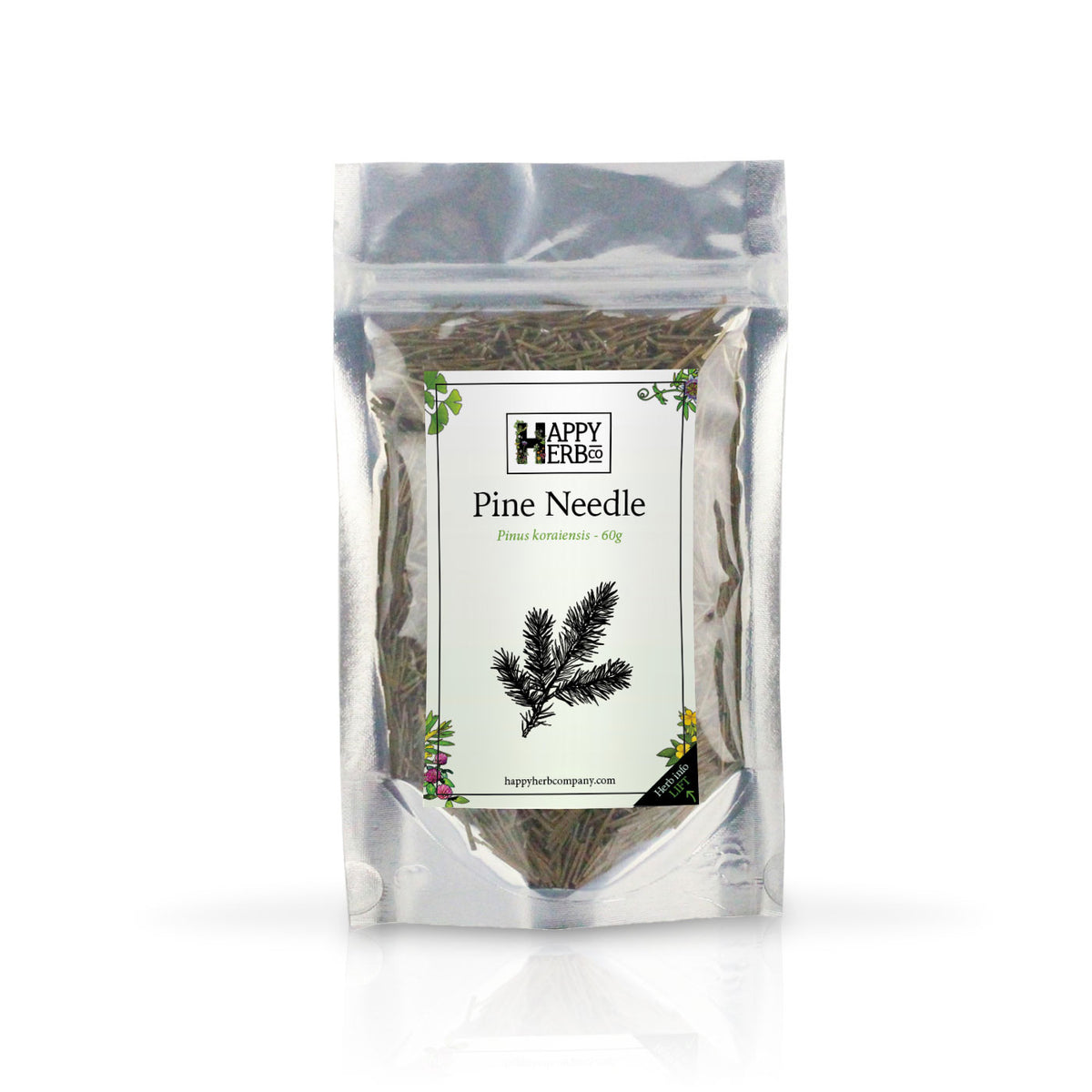
Pine Needle (Pinus koraiensis) is the needle-like leaf of the Korean Pine, a tall evergreen conifer of East Asia. Pine needles have long been used in Korea as a food and a tea, and drinks made from conifer needles have a history in northern Europe and North America as well.
The taste is fresh and resinous, with a light, clean finish. Most people take Pine Needle as a tea, and it is the herb our customers reach for through winter, when they want a bright, forest-scented cup as part of looking after themselves.
In Korea, pine needles have long been used as a traditional health-promoting food(1), and Korean Pine is one of the trees whose needles are gathered for tea.
In the West, conifer needles belong to the story of scurvy. On Jacques Cartier's second voyage, in 1535 to 1536, his crew learned from the Iroquois to make a decoction of the bark and needles of a conifer known as annedda, the 'tree of life'(2). In the eighteenth century Swedish soldiers drank a preparation of pine needles, and during the siege of Leningrad in 1942 a pine needle drink was served in canteens, schools and factories across the city(2).
The custom carries on. Pine needle tea is part of Estonian folk medicine, and in Korea the needles are sold today as tea, powder and wine(3).
The needles of Pinus koraiensis (Korean Pine) contain volatile terpenes such as α-pinene and camphene, together with polyphenols, flavonoids, proanthocyanidins and phenolic acids, and moderate amounts of vitamin C(3). These constituents give the needles their resinous, fresh-pine aroma. In preliminary laboratory models, needle extracts and the essential oil are studied for effects on lipid metabolism, oxidative stress and inflammation(4).
Pine Needle sits at the edge of Western herbalism. It is a folk tea more than a classic herb of the dispensary, and herbalists who use it class it as an aromatic expectorant, blended with Mullein, Horsetail or Nettle.
People drink it through winter, after time outdoors, and as a caffeine-free cup with a clean, resinous scent.
Its name as a vitamin C drink deserves care. A 2018 study found the vitamin C in conifer needles rather low compared with other natural sources, and lower again once the needles were dried(2). Other research has looked at the aromatic oils and polyphenols of pine needles in the laboratory and in early models, not in people(3, 4). So we describe how it is used, not what it will do.
Developed and reviewed by Laura Grace, Owner and Creative Director of Happy Herb Co, Herb Educator and Registered Ayurvedic Lifestyle Consultant · Clinically reviewed by Tamara Welsh, BSc, AdvDipWHM, ATMS, Clinical Herbalist
This profile is intended as a researched educational guide and does not replace the broader perspective of a herbal consultation.
★★★★★
4.8 out of 5, from 5 reviews
I was recommended pine needle tea in combination with some other bits and pieces to help improve my gut health. This tea is so robust it needs 15 min to steep.
I did also purchase their tea strainer and I love that little device. Finally the order arrived just days after I ordered it and I’ll be back for sure
Amazing Leanne thank you so much! We are so happy to hear you are loving our Pine Needle as a tea and have been using our tea strainer with it too!
It’s a little lighter in taste than what we previously had but still a good product
Hi Laura, Thank you for the review! We are glad you are enjoying the pine needle tea. Cheers!
The tea is very nice, mild to taste. Order came in quickly and nicely packaged.
Amazing.
Great product
Hi,
Thank you for your review! Glad to hear you are enjoying the pine needle tea.
Cheers,
Happy Herb Co
In everyday life
Pine Needle is used in two main ways.
Pine Needle tea is mostly drunk through the winter months.
A forest in the cup.
Crush a few needles between your fingers and smell the resin. Pine needle tea was drunk by First Nations peoples through the North American winter, and by sailors on long voyages.
Crush two or three grams of needles to break the waxy coat, steep them for ten minutes, and add lemon. Drink it standing at an open door, if the weather allows.
Sip slowly. The needles stay green through the hardest months. What stays green in you through a long winter?
Shop

Single Herb
FAQ
Pine Needle tea is made from the needles of the Korean Pine (Pinus koraiensis), a tall evergreen conifer of East Asia. Pine needles have long been used in Korea as a health-promoting food, and conifer needle drinks have a history in Europe and North America as well. The tea is fresh and resinous, and naturally caffeine free.
Pine Needle is long associated with winter wellness and easy breathing. In Korea the needles are a traditional health-promoting food, and herbalists who use Pine Needle class it as an expectorant. Research so far has been done in the laboratory, not in people, so we describe how it is used, not what it will do.
Pine Needle is best known as a herb people reach for when they want a fresh, resinous cup as part of looking after themselves in the colder months. Most people drink it through winter, often blended with Nettle or Mullein. Its vitamin C content is lower than its reputation suggests, so it does not replace fruit and vegetables.
Crush or grind 2 to 3 grams of Pine Needle to break down the needles' protective coating. Steep in a cup of just-boiled water, covered, for 10 minutes, then strain. The flavour is fresh and resinous, and lemon or honey can be added to taste.
No. Pine Needle is naturally caffeine free, so the tea can be drunk at any time of day, including the evening. It is made from the needles of a conifer, not from the tea plant, and its character comes from its fresh, resinous scent.
A little. Pine Needle has a long reputation as a vitamin C drink, and conifer needle preparations were used against scurvy from the 1500s. When a 2018 study measured conifer needles, though, it found the vitamin C rather low compared with other natural sources, and lower again in dried needles. Pine Needle tea is best enjoyed for its flavour.
Pine Needle tea should be avoided during pregnancy, because its safety in pregnancy is untested. That is the only precaution on our records for Pine Needle. If you take medication or have a health condition, check with your health professional first.
People ask because of a claim that spread online in 2021. The story went that pine needles contain shikimic acid, that shikimic acid is the starting material for an antiviral medicine, and that the tea therefore protected against the virus, or against people who had been vaccinated. Sales of pine needle tea jumped in several countries on the strength of it.
The chain does not hold. Pine needles do contain shikimic acid, but so do many plants, and the compound is a starting point for making a medicine in a factory, not a medicine in itself. No study has tested pine needle tea against COVID-19, and the claim was examined and rated false by fact-checkers at the time. We sell Pine Needle for what it is: a resinous winter tea with a long folk history, and nothing more.
Its safety during pregnancy is untested and therefore should be avoided whilst pregnant.
This herb has not been studied enough for its actions to be defined. What we know of it comes from tradition and the sources below.