Dragon's Blood Profile
Dragon's Blood
Croton lechleri
For skin resilience, protective presence and ceremonial use.


Cart
Your cart is empty

Join us in our love of herbs
Dragon's Blood Profile
Croton lechleri
For skin resilience, protective presence and ceremonial use.
Herbal Intelligence
Dragon's Blood (Croton lechleri) is the deep red sap of a rainforest tree native to the upper Amazon, mainly Peru and Ecuador. Known in Spanish as sangre de grado, it has been used by the peoples of the western Amazon for centuries, mostly on the skin.
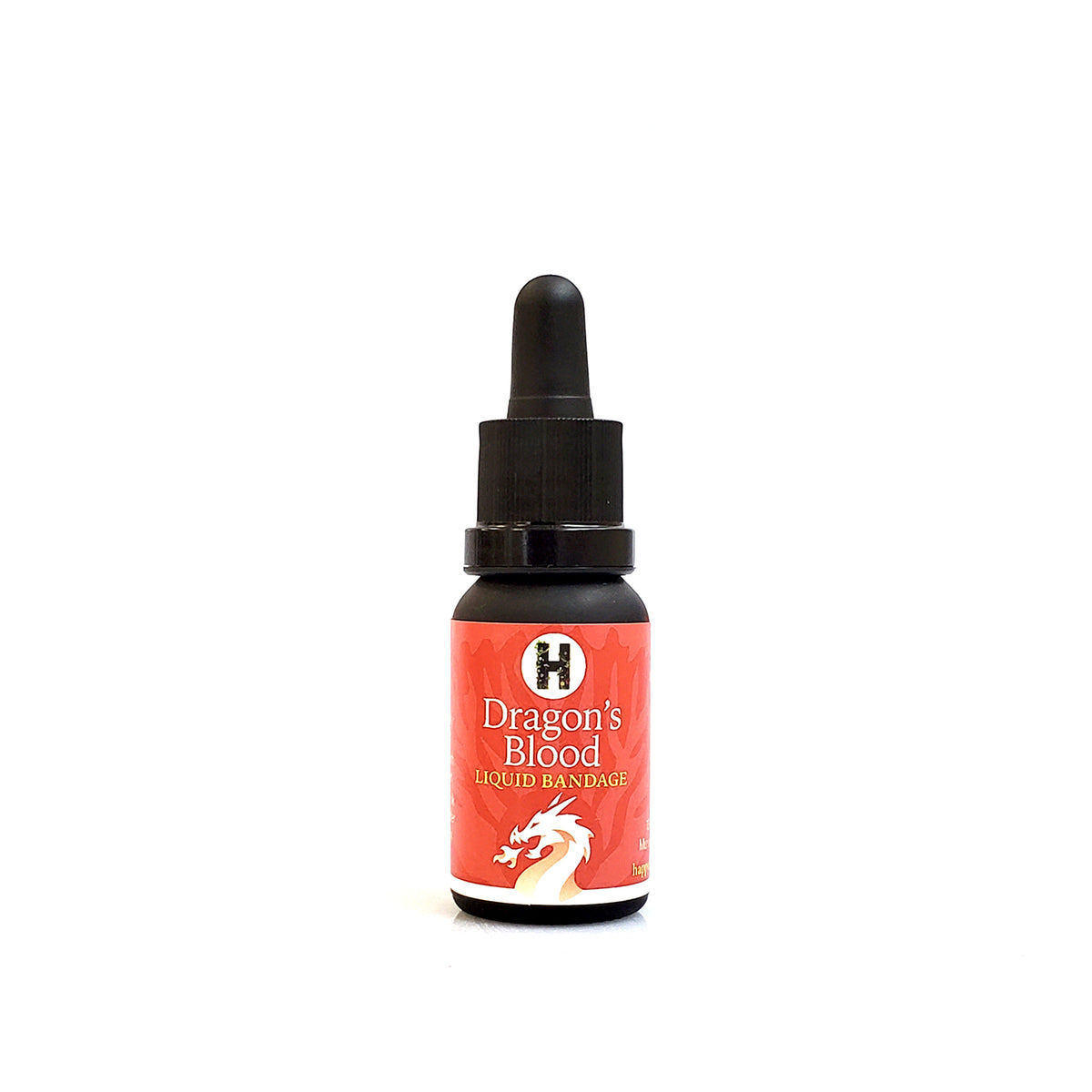
It is a thick liquid with an earthy, resinous smell and a strongly astringent taste. Dabbed onto the skin it dries to a thin film, which is how it earned its nickname, liquid bandage. Most people use it that way, a few drops at a time, and it is what our customers keep in the first aid kit and the bathroom cabinet, for the moments when skin needs a protective layer.
The Spanish names, sangre de grado and sangre de drago, describe what happens when the bark of the tree is cut: it releases a wine-red latex(1, 2). Croton lechleri grows in the lowland and upland Amazon of Peru and Ecuador, and the first written accounts of the sap's use date from the 1600s(1).
In Amazonian households the sap is put straight onto the skin over cuts and insect bites, and taken by the drop for the stomach and gut(1, 2). Those uses continue today(1).
The name causes some confusion. Dragon's blood is also the name for the red resins of several unrelated plants, among them Dracaena dragon trees and Daemonorops rattan palms, long used as varnish and colouring(3). The Amazonian sap is a different material: a liquid latex, not a hard resin.
The sap of Croton lechleri is made up mostly of proanthocyanidins, a group of condensed tannins that account for at least 90 per cent of its dry weight(1). It also contains the alkaloid taspine, first isolated from the sap in 1979, and lignans such as 3',4-O-dimethylcedrusin(1). The balance of these compounds varies with where the tree grows(2).
In the laboratory the proanthocyanidins and taspine are studied for their effects on wound closure, on inflammation and on viruses(2, 3).
In Western herbalism Dragon's Blood is thought of as a skin herb first: an astringent, film-forming sap kept on hand for everyday knocks, and increasingly an ingredient in skin care. Rubbed with a fingertip it turns from a red liquid to a pale paste that dries as a thin layer over the skin.
It is a sap that researchers have taken seriously. In the 1990s a purified extract of its proanthocyanidins, known as SP-303, was developed from it(1), and clinical studies of sangre de grado products followed(2). Most research on the whole sap, though, has been done in the laboratory and in animals(1, 2), so we describe how it is used, not what it will do.
Developed and reviewed by Laura Grace, Owner and Creative Director of Happy Herb Co, Herb Educator and Registered Ayurvedic Lifestyle Consultant ·
This profile is intended as a researched educational guide and does not replace the broader perspective of a herbal consultation.
In everyday life
Dragon's Blood sap is used in two main ways.
Dragon's Blood is used as the need arises, not as a daily routine.
What the tree does for itself.
Put a drop of the sap on the back of your hand and watch it. Deep red, then as it dries it turns to a thin, clear film. This is what the croton tree does to close its own wounds when the bark is cut.
Leave the drop to dry fully before you move on, a minute or two. It is a small lesson in not picking at things.
Breathe slowly. The tree seals the cut and keeps growing. What have you been reopening that would close on its own if you let it?
Shop
Self-Care
FAQ
Dragon's Blood (Croton lechleri) is the deep red sap of a rainforest tree native to the upper Amazon, mainly Peru and Ecuador. Known in Spanish as sangre de grado, it has been used by the peoples of the western Amazon for centuries. Today it is mostly applied to the skin, a few drops at a time, where it dries to a film that has earned it the nickname liquid bandage.
Dragon's Blood is long associated with the skin. In Amazonian households the sap is put straight onto the skin and taken by the drop for the stomach and gut, and Western herbalists think of Dragon's Blood as an astringent, film-forming skin herb. Most research on the whole sap has been done in the laboratory and in animals, so we describe how it is used, not what it will do.
Dragon's Blood is best known as a herb people reach for when skin needs a protective layer: after gardening, bushwalking, or a day outdoors with children. Most people use it as the need arises, not every day, and keep a bottle in the first aid kit or the bathroom cabinet.
Shake the bottle and put a few drops of Dragon's Blood on clean skin. There is no need to rub it in. Left to dry, the sap forms a thin film over the skin, which is why it is nicknamed liquid bandage. It can stain fabric, so give it a minute before dressing.
No. Dragon's Blood is the sap of an Amazonian tree and contains no caffeine. It is strongly astringent and rich in tannins, and most people use it on the skin, a few drops at a time, rather than drink it.
No. Several unrelated plants give a red product called dragon's blood. The hard resin sold as incense and varnish comes from Dracaena dragon trees and Daemonorops rattan palms. The Dragon's Blood described here is the liquid sap of Croton lechleri, an Amazonian tree, and it is used on the skin.
Take Dragon's Blood internally with caution if you have constipation. Most people use it on the skin and not as a drink. If you take medication or have a health condition, check with your health professional first.
Use with caution internally if you have constipation.
As described in the monographs cited under Sources.