Calendula Profile
Calendula
Calendula officinalis
For gentle radiance and skin care.


Cart
Your cart is empty

Join us in our love of herbs
Calendula Profile
Calendula officinalis
For gentle radiance and skin care.
Herbal Intelligence
Calendula (Calendula officinalis) is a golden-flowered annual of the daisy family from the Mediterranean region. Also called pot marigold, it has been a kitchen and household herb in Europe for centuries.
The petals taste mild, a little bitter and faintly floral, and they turn a cup golden. Most people take Calendula as a tea, or use it on the skin as an infused oil, balm or wash. It is the herb our customers reach for when they want something gentle and bright, and when their skin wants looking after.
Calendula takes its name from the Latin calendae, the first day of the month(1). The usual explanation is that the plant seemed to be in flower at the start of every month. The genus is native to the Mediterranean(2), and the old name pot marigold marks it as a potherb: the petals were added to soups, salads and rice for colour and flavour(1).
It was a favourite of English gardens in Shakespeare's time(1). Medieval writers recorded the flowers for the liver and the heart, and by the 1700s they were being used for headache and sore eyes(2). During the American Civil War Calendula was used on wounds(2).
That last use is the one that lasted. Calendula is still best known as a herb for the skin, made into creams, oils and washes, and it appears in close to 200 cosmetic preparations(2).
The orange and yellow petals of Calendula (Calendula officinalis) contain triterpene saponins, flavonoids such as quercetin and isorhamnetin, and carotenoids such as lutein and zeaxanthin(3). In the laboratory these compounds are studied for antioxidant activity and for their effects on local inflammatory responses in the skin and mucous membranes(4).
In Western herbalism Calendula is classed as a vulnerary, a herb for the skin, and it is used more on the outside of the body than the inside. The European Medicines Agency recognises Calendula flower as a traditional herbal medicine for minor inflammation of the skin, minor wounds, and minor inflammation of the mouth and throat(4).
People make it part of everyday care: a balm kept by the sink, an infused oil after a day in the garden, a cooled tea used as a wash or a gargle. As a tea it is drunk for its mild flavour and golden colour.
Research on Calendula is modest. A 2019 systematic review of Calendula extract and wounds found 14 studies, half of them in animals, and called for larger, better-designed trials(5), so we describe how it is used, not what it will do.
Developed and reviewed by Laura Grace, Owner and Creative Director of Happy Herb Co, Herb Educator and Registered Ayurvedic Lifestyle Consultant · Clinically reviewed by Tamara Welsh, BSc, AdvDipWHM, ATMS, Clinical Herbalist
This profile is intended as a researched educational guide and does not replace the broader perspective of a herbal consultation.
★★★★★
5.0 out of 5, from 3 reviews
Great addition to any blend, doesn't have a strong taste or smell so is perfect for any beginner to herbal teas. Works great as either a tea or smoking herb, tastes delicious both ways. Super soft, light and yummy.
Great review thanks. Have you tried infusing it in oil. Choose an oil you don't mind using on your body, my favourite is Moringa oil, and soak for at least one month, it will then give you a wonderful skin healing oil. Thanks Laura
So stoked with the purchase thanks so much quick as shipping can't complain at all! :)
Hi Shay, Thank you for your review about the calendula petals! We really appreciate you taking the time to share your feedback. Thanks again for your order
Yes 💜 just what I needed to bulk out my own personal tea blend🍵
In everyday life
Calendula petals are used in four main ways.
Calendula suits everyday use, in the cup and on the skin.
Keep something bright on hand.
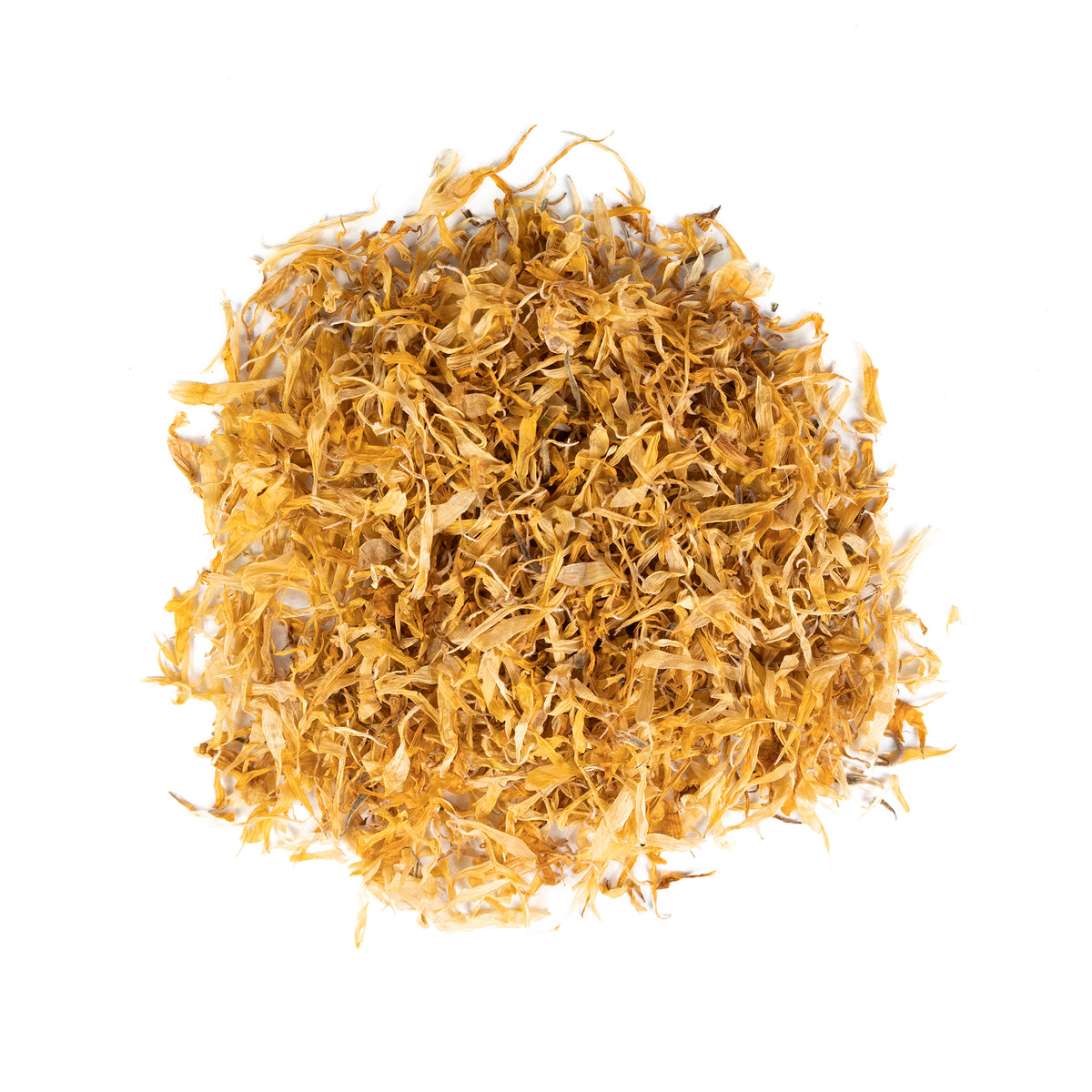
Take a few of the dried petals in your palm. Even dried, they hold their orange. Calendula follows the sun across the day and closes its flower at dusk.
Steep the petals for a cup, or scatter a pinch over a salad or a bowl of rice, the old potherb way. Notice how a little colour changes a plain thing.
Sip slowly. Brightness is not the same as loudness. What simple, bright thing could you keep within reach this week?
Shop

Single Herb


Luxury Tea
A clean, bright tea of nettle, red clover, ginger, dandelion and peppermint.


Luxury Tea
A spicy tea of cinnamon, licorice, ginger, orange and rooibos.


Luxury Tea
An after-dinner tea of peppermint, licorice, ginger, fennel and calendula.
FAQ
Calendula (Calendula officinalis) is a golden-flowered annual of the daisy family, also known as pot marigold. It has been a kitchen and household herb in Europe for centuries. Today the petals are taken as a tea, used on the skin as an oil or balm, and scattered over food. It is not the same plant as the garden marigold, Tagetes.
Calendula is long associated with skin care and gentle everyday teas. Western herbalists class it as a vulnerary, a herb for the skin, and use it more on the outside of the body than the inside. As a potherb its petals went into soups and salads. A 2019 review of 14 studies called for larger trials, so we describe how it is used, not what it will do.
Calendula is best known as a herb people reach for when their skin wants gentle, everyday looking after. Most people keep an infused oil or balm for after a day in the garden, or use a cooled tea as a wash. As a tea, Calendula is drunk at any time of day, on its own or in a blend.
Steep 1 to 2 teaspoons of dried Calendula petals in a cup of just-boiled water, covered, for 10 minutes, then strain. The same tea, once cooled, can be used as a skin wash or a gargle.
No. Calendula is naturally caffeine free, so the tea can be enjoyed at any time of day. The petals are mild, a little bitter and faintly floral. They colour a cup golden and blend easily with Chamomile, Rose or Lavender.
Calendula petals are used in milled herb blends, where they add colour and a light, soft body to the mix. They are not usually smoked on their own. Inhaling smoke is harmful; we describe how the herb is used, we do not suggest it.
Avoid Calendula if you are allergic to plants in the daisy family (Asteraceae). Occasional allergic skin reactions have been reported. If you are pregnant or breastfeeding, take medication or have a health condition, check with your health professional first.
Avoid Calendula if you are allergic to plants of the daisy family (Asteraceae). Occasional allergic dermatitis has been reported. If you are pregnant or breastfeeding, check with your health professional first.
As described in the monographs cited under Sources.