Horny Goat Weed Profile
Horny Goat Weed
Epimedium sagittatum
For heat, drive and physical vitality.


Cart
Your cart is empty

Join us in our love of herbs
Horny Goat Weed Profile
Epimedium sagittatum
For heat, drive and physical vitality.
Herbal Intelligence
Horny Goat Weed (Epimedium sagittatum) is a low, leafy perennial of the barberry family, native to China. Its leaves, known in Chinese herbal tradition as yin yang huo, appear in the earliest Chinese herbals and have been taken ever since as a tonic for vitality and desire.
The taste is mild and earthy. Most people take Horny Goat Weed as a tea or a liquid extract, and it is the herb our customers reach for when they want to feel more drive and physical vitality, and to make room for intimacy.
Horny Goat Weed was first documented in the Shennong Materia Medica Classic, the earliest of the Chinese herbals(3). The story behind its English name is set in the Northern and Southern Dynasties, some fifteen hundred years ago. A herdsman noticed that his flock grew more amorous after grazing on a wild plant and told the physician Tao Hongjing, who watched for himself and recorded the herb(3).
The plant has many names. In Chinese it is yin yang huo or xian ling pi, and in English the same genus is called Barrenwort, Bishop's Hat and Fairy Wings(1). About 52 species of Epimedium are known(1). Epimedium sagittatum is one of four whose dried leaves are accepted as the official herb in China(3).
The leaves are still widely used in China, Japan and South Korea. One old preparation is a tonic wine, made by steeping the leaves in alcohol(3).
Horny Goat Weed is the aerial parts of Epimedium species, including Epimedium sagittatum. The herb contains a group of prenylated flavonoids, most notably icariin, alongside epimedins A, B and C, lignans and polysaccharides(2). In the laboratory these compounds are studied for their effects on nitric oxide signalling, the relaxation of blood-vessel muscle, bone metabolism and immune-cell activity(3).
In Western herbalism Horny Goat Weed is classed as an aphrodisiac and a tonic. Both ideas are borrowed from Chinese practice, where it is a yang tonic: a herb for vitality, strength and drive(3).
People use it around intimacy and the evening, often in teas and liquid blends made for two, alongside Damiana, Maca or Rose. Others take it daily for a few weeks at a stretch, when energy and drive feel low.
Most of the research so far is laboratory work on icariin, the leaf's best-known flavonoid(3). Memorial Sloan Kettering Cancer Center describes the scientific evidence in people as limited, and says more studies are needed to confirm how safe and how useful the herb is(4). So we describe how it is used, not what it will do.
Developed and reviewed by Laura Grace, Owner and Creative Director of Happy Herb Co, Herb Educator and Registered Ayurvedic Lifestyle Consultant ·
This profile is intended as a researched educational guide and does not replace the broader perspective of a herbal consultation.
In everyday life
Horny Goat Weed leaf is used in three main ways.
The tea can be taken up to three times a day. Many people take Horny Goat Weed for a few weeks at a time, not all year round.
The goatherd noticed first.
Look at the leaf, heart-shaped and a little leathery. The story goes that a Chinese goatherd saw his animals grow lively after grazing on it, and the name has outlasted every attempt to replace it.
Steep a teaspoon or two with damiana or rose, and drink it somewhere you feel at ease in your own skin.
Sip slowly. The goatherd paid attention to what was in front of him. What is right in front of you that you have stopped noticing?
Shop
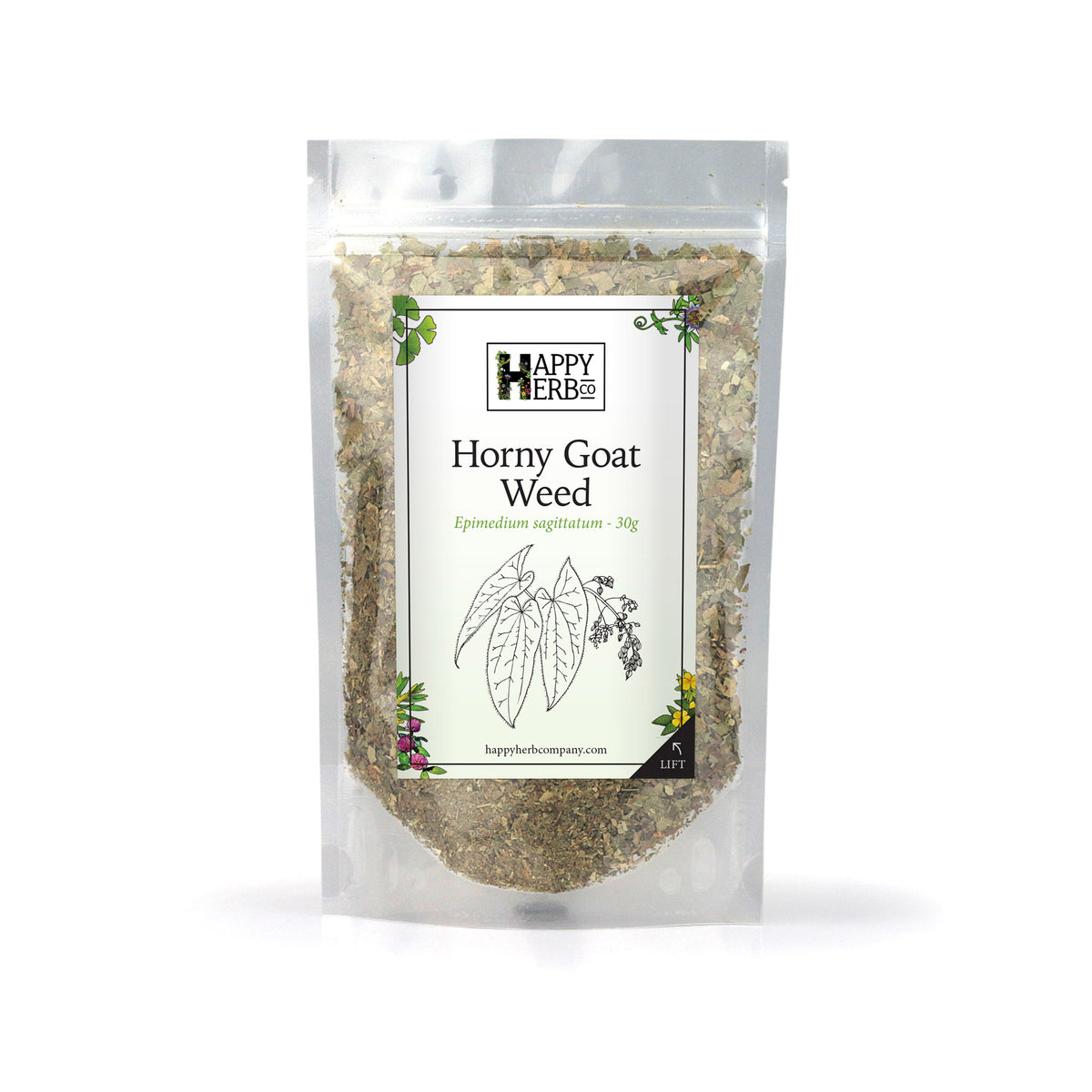
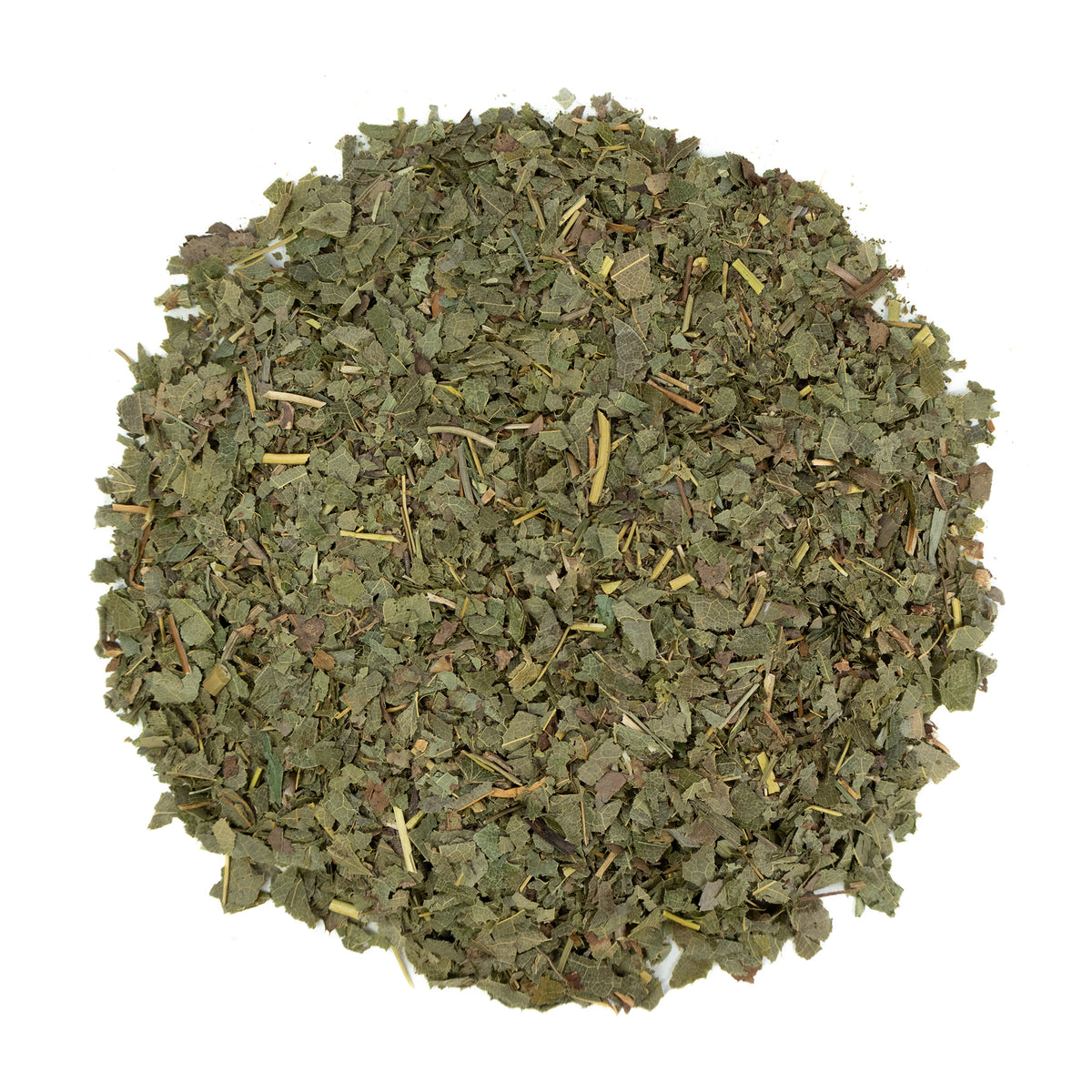
Single Herb
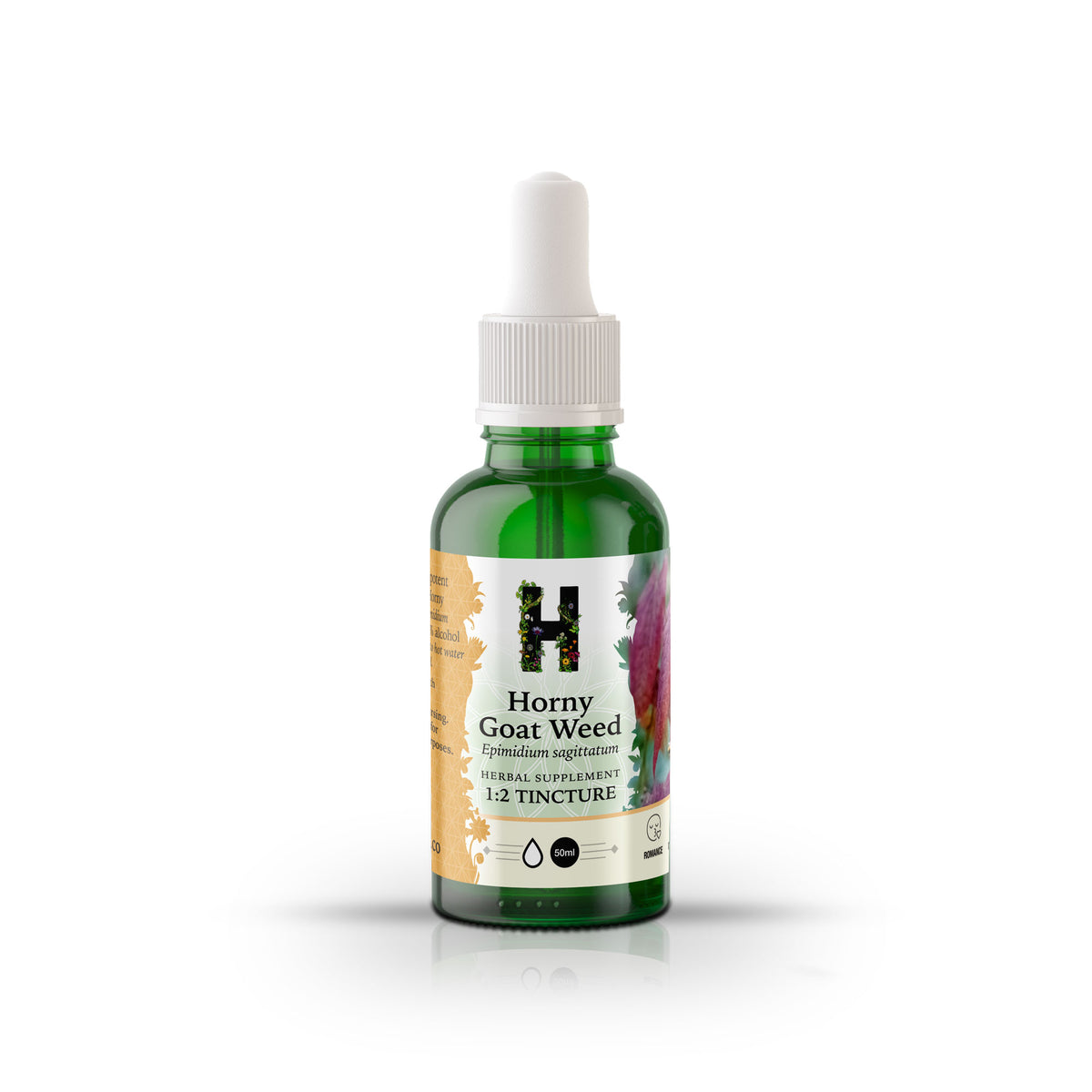
Botanical Concentrate

Spagyric

Tea Elixir
A herbal concentrate of damiana, muira puama, maca, tribulus and vanilla.
FAQ
Horny Goat Weed (Epimedium sagittatum) is a low, leafy perennial of the barberry family, native to China. Its leaves, known in Chinese herbal tradition as yin yang huo, appear in the earliest Chinese herbals and have long been taken as a tonic for vitality and desire. Today Horny Goat Weed is taken as a tea or a liquid extract.
Horny Goat Weed is long associated with desire, drive and physical vitality. In Chinese herbal tradition, where it is called yin yang huo, it is taken as a yang tonic, and Western herbalists class it as an aphrodisiac and a tonic. Most research is laboratory work on its flavonoid icariin and evidence in people is limited, so we describe how it is used, not what it will do.
Horny Goat Weed has a long cultural history as a herb for desire and drive. Some people take it as a tea or a liquid extract daily for a few weeks, following the Chinese idea of a tonic. Others keep Horny Goat Weed for evenings with a partner.
Steep 1 to 2 teaspoons of dried Horny Goat Weed leaf in a cup of just-boiled water, covered, for 10 minutes, then strain. The flavour is mild and earthy. Damiana, Rose or Ginger all blend well with it, and honey can be added to taste.
No. Horny Goat Weed is naturally caffeine free, so the tea can be taken in the evening without the lift of tea or coffee. Its reputation is as a tonic for drive and vitality, not as a stimulant.
There is not enough research to say. Memorial Sloan Kettering Cancer Center notes that scientific evidence on Horny Goat Weed is limited, that more studies are needed to confirm its safety, and that prolonged use may change how the body processes some medicines. If you plan to take Horny Goat Weed daily for more than a few weeks, talk to a health professional first.
Use Horny Goat Weed with caution if you have a bleeding disorder or low blood pressure, and stop taking it two weeks before surgery. It is not recommended for people with heart disease. Memorial Sloan Kettering Cancer Center lists sweating, a rapid or irregular heartbeat and mood changes among its reported side effects. If you take medication or have a health condition, check with your health professional first.
Caution in individuals with bleeding disorders or low blood pressure. Discontinue use two weeks prior to surgery. Not recommended for people with heart disease.
As described in the monographs cited under Sources.