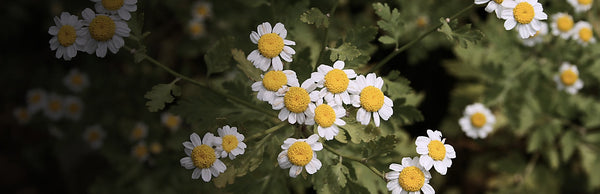
Feverfew
Shipping calculated at checkout
Feverfew: A Foundational Practice for a Clear and Steady Head
Head heaviness, met with intention. Specific and purposeful, Feverfew is a herb for those who experience recurring patterns of head discomfort and pressure. Long valued in Western herbalism, it’s recognised for its consistently over time rather than acutely; for those who prefer a more considered, steady approach.
- Character
- Bitter · Aromatic · Crisp
- Companion for
- Head clarity · Steady presence · Long term ease
- Pairs well with
- , ,
White Willow (Salix alba) is a tall, fast-growing tree of the willow family, native to Europe and western and central Asia. Its bark has been used since antiquity, and it is remembered as the plant that led chemists to salicylic acid and, in time, to aspirin.
The taste is bitter and astringent. Most people simmer the bark into a tea, and it is the herb our customers reach for on the days when the body feels stiff, heavy or sore and they want physical ease.
Meadowsweet (Filipendula ulmaria) is a tall perennial of the rose family, native to Europe and western Asia, where it grows in damp meadows and along stream banks. Its frothy, cream-coloured flowers have flavoured drinks since the Bronze Age, and its old Latin name, Spiraea, is the 'spir' in aspirin.
The taste is sweet, floral and mild, with an almond-like scent. Most people take Meadowsweet as a tea, on its own or blended with Chamomile, and it is the herb our customers reach for after a meal, when the stomach wants settling.
Ginger (Zingiber officinale) is a leafy perennial native to tropical Asia, grown for its knobbly, aromatic rhizome. It has been used as both a spice and a household herb in India and China for thousands of years, and it is now one of the most widely eaten plants in the world.
The taste is spicy and zesty, with a lemony sweetness. Most people take Ginger as a tea, fresh or dried, or as a liquid extract, and it is the herb our customers reach for after a meal, or whenever the stomach wants settling.
Ingredients
Contents: Feverfew (Tanacetum parthenium) dried herb
Herbal Intelligence
Phytochemistry
Feverfew leaves contain sesquiterpene lactones, of which more than 30 have been identified. The best known is parthenolide, found in tiny glands on the leaf surface, and it is the compound most often measured in research.
Living tradition
Feverfew's recorded history begins with the Greeks. In the first century the physician Dioscorides wrote of it as a herb for fever and inflammation, and the Greeks called the plant parthenium: one story holds that it saved the life of a workman who fell from the Parthenon during its construction.
Suggested use
2 grams (1 teaspoon) per serve. Brew in a pot for 10 mins and sweeten if desired.
Specifications
- Other Names
- Tanacetum parthenium.
- Range
- Dried Herbs & Powders
- Grown In
- Australia
- Organic Status
- Wild harvested where possible.
- Plant Parts
- Ariels
- Packaging
- Currently in disposable plastic, moving towards home compostable.
Vegan Friendly
Precautions
- Cautioned in individuals with known allergy to the Asteraceae family
- Caution in pregnancy
Happy Herb Co shares referenced knowledge about herbs and makes no therapeutic claims for its products. If you are pregnant, breastfeeding, taking medication or managing a health condition, please speak with a health professional before using any herb.
Choose options
Explore