

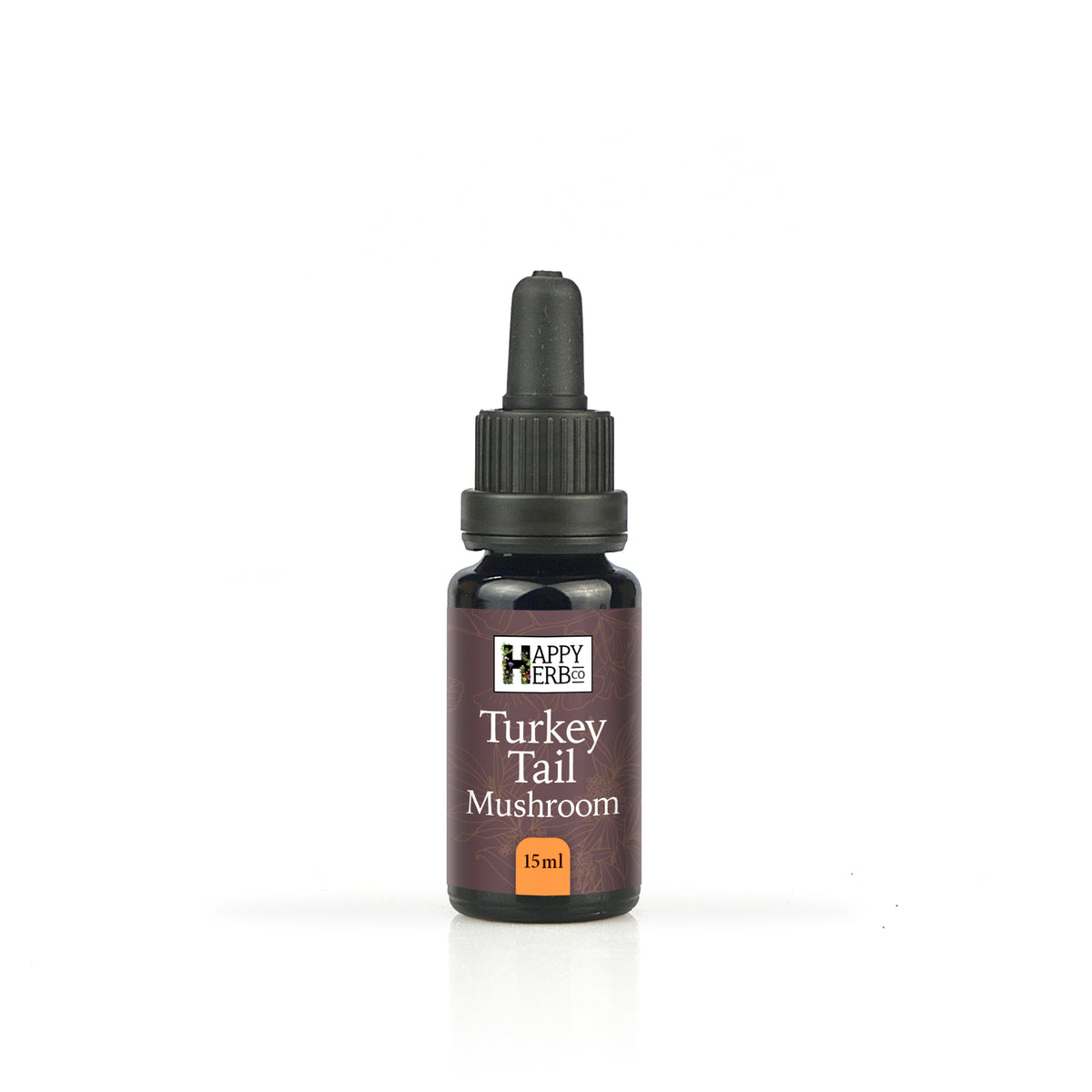
Turkey Tail Spagyric
Shipping calculated at checkout


Turkey Tail Spagyric — A Foundational Practice for Immune Intelligence
One of the most researched medicinal mushrooms in the world, Turkey Tail is chosen by those who want to build deep, long-term immune resilience. Long valued in TCM and Japanese herbal medicine for its remarkable affinity with the immune system and its broad-spectrum protective qualities. A mushroom for those who take their immune health as seriously as their daily practice.
This Turkey Tail Spagyric is crafted through traditional alchemical practice to capture the herb's vital essence. As part of our Spagyric range, it offers a subtle yet complete expression of the mushroom — for those drawn to the deeper energetic and vibrational qualities of herbalism.
- Character
- Mild · Earthy · Subtle
- Companion for
- Immune resilience · Long-term protection · Gut health
- Pairs well with
- , ,
Reishi (Ganoderma lucidum) is a glossy, red-brown bracket mushroom that grows on hardwood trees, native to East Asia. Known in China as lingzhi, it has been taken as a tonic in Asia for over two thousand years, and it is often called the mushroom of immortality.
The taste is bitter, earthy and rich. Reishi is too woody to eat, so most people take it as a liquid extract, as a powder stirred into a hot drink, or in capsules. It is the herb our customers reach for as a daily tonic, when they want to feel calm, steady and well resourced over the long run.
Chaga (Inonotus obliquus) is a fungus that grows on birch trees in the cold forests of the northern hemisphere. It forms a hard, black, charcoal-like growth on the trunk, and it has been brewed as a tea in Siberia, Russia and northern Europe for centuries.
The taste is mild and earthy with a faint bitterness, closer to black tea than to a mushroom. Most people take Chaga as a tea, a liquid extract or a powder stirred into a hot drink, and it is the one our customers reach for in winter, when they want something steady and nourishing in the daily cup.
Astragalus (Astragalus membranaceus) is a perennial of the pea family, native to northern China and Mongolia. Its long, sweet root, known as huang qi, has been one of the central tonic herbs of Chinese herbal tradition for around two thousand years.
The taste is mild, sweet and earthy, closer to food than to medicine. Most people simmer the sliced root into a tea, a broth or a pot of soup, and it is the herb our customers reach for ahead of winter, when they want to build themselves up for the season.
Ingredients
Spagyric of Turkey Tail.
Contains alcohol: triple filtered spirit for extraction and preservation.
Suggested use
- How often
- Up to 3 times a day
- A serve
- 5 drops under the tongue, held for as long as is comfortable (sublingual), or in a little warm water
Specifications
- Form
- Liquid Concentrate
- Range
- Spagyrics
- Extraction
- Spagyric technique in accordance with Paracelsus and the hermetic philosophy: slow cold extraction, long maceration, calcination of the plant to recover its salts, and astrological and energetic alignment. What is a spagyric?
- Concentration
- 1:2
- Packaging
- Reusable UV Glass Bottle
Precautions
Happy Herb Co shares referenced knowledge about herbs and makes no therapeutic claims for its products. If you are pregnant, breastfeeding, taking medication or managing a health condition, please speak with a health professional before using any herb.
Choose options