Andrographis Profile
Andrographis
Andrographis paniculata
For seasonal defence, first response and immune support.


Cart
Your cart is empty

Join us in our love of herbs
Andrographis Profile
Andrographis paniculata
For seasonal defence, first response and immune support.
Herbal Intelligence
Andrographis (Andrographis paniculata) is a slender annual herb native to India and Sri Lanka, known across Asia as the King of Bitters. Its leaves and stems have been part of Ayurvedic, Chinese and Thai herbal traditions for centuries.
The nickname is earned: Andrographis is one of the most intensely bitter herbs there is. Most people take it as a small, strong cup of tea, or as a liquid extract, and it is the herb our customers reach for when the seasons change and they want their defences looked after.
Andrographis has been used in India for centuries. In Hindi and Bengali it is kalmegh, 'dark cloud', and in Sanskrit bhunimba, 'neem of the ground', a nod to a bitterness that rivals the neem tree. It is listed in the Indian Pharmacopoeia and appears in at least 26 Ayurvedic formulas(1).
The same plant travelled east. In Chinese herbal medicine it is chuan xin lian, counted among the strongly bitter herbs, and in Thailand it is known as fah talai jone(1, 2).
Across these traditions the pattern is much the same: a very bitter herb taken for a short stretch when the seasons turn or the body is under pressure, and in small amounts before food as a digestive bitter(1, 2).
The leaves and aerial parts of Andrographis contain a group of compounds known as diterpene lactones, of which the most studied is andrographolide. In the laboratory these compounds are studied for how they act on signalling pathways in immune cells and on oxidative stress responses(3).
In Western herbalism Andrographis is classed as a bitter tonic and an immune herb, and it is often paired with Echinacea in seasonal formulas. Herbalists tend to use it in short bursts rather than every day.
It is also one of the more closely studied herbs. The World Health Organization has published a monograph on it(2), the European Medicines Agency an assessment report(3), and a 2017 systematic review gathered 33 clinical trials of Andrographis in seasonal respiratory complaints(5).
The reviewers found the results encouraging but rated many of the trials as limited in quality, and called for better ones(5). As always, we describe how Andrographis is used, not what it will do.
In September 2026 Australia's Therapeutic Goods Administration removed Andrographis from the ingredients permitted in new listed medicines, because of the risk of severe allergic reactions, which can occur even in people who have taken it before without trouble(6).
Developed and reviewed by Laura Grace, Owner and Creative Director of Happy Herb Co, Herb Educator and Registered Ayurvedic Lifestyle Consultant · Clinically reviewed by Tamara Welsh, BSc, AdvDipWHM, ATMS, Clinical Herbalist
This profile is intended as a researched educational guide and does not replace the broader perspective of a herbal consultation.
In everyday life
Andrographis is taken in two main ways.
Andrographis is traditionally taken for short stretches, not as an everyday tea.
Meet the bitterness.
Crush a little of the dried leaf and taste the smallest fragment. The bitterness arrives at once and stays. In Ayurveda this is the King of Bitters, and it does not pretend otherwise.
Make a small, strong cup rather than a full mug, with honey and a slice of ginger beside it. Sit somewhere plain and let the first sip be exactly what it is.
Sip slowly. Not everything worth taking is pleasant. What in your life have you been sweetening that might be better met straight?
Shop
Single Herb
FAQ
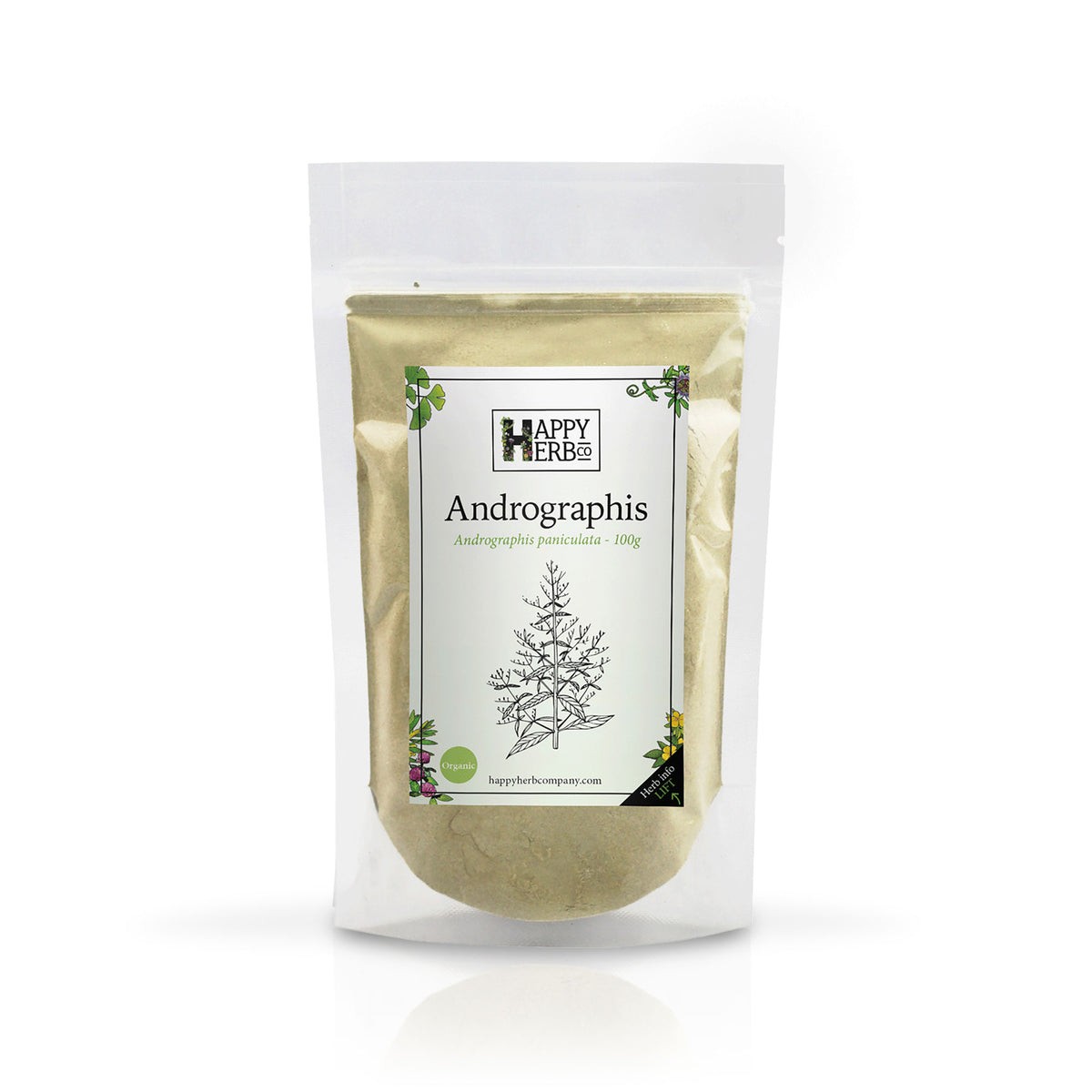
Andrographis (Andrographis paniculata) is a slender annual herb native to India and Sri Lanka, known as the King of Bitters. Its leaves and stems have been used in Ayurvedic, Chinese and Thai herbal traditions for centuries. Today it is taken as a tea or as a liquid extract.
Andrographis is long associated with immune action and digestion. In Ayurvedic, Chinese and Thai traditions it is taken for a short stretch when the seasons turn, and in small amounts before food as a digestive bitter. Western herbalists class it as a bitter tonic. Clinical trials are encouraging but limited in quality, so we describe how it is used, not what it will do.
Andrographis is best known as a herb people reach for when the seasons change and they want their defences looked after. Most people take it for short stretches, as a small, strong cup of tea or a liquid extract, rather than every day. Herbalists often pair it with Echinacea in seasonal formulas.
Steep 1 to 2 teaspoons of dried Andrographis in a cup of just-boiled water, covered, for 10 minutes, then strain. Add honey, ginger or lemon to soften the bitterness. Many people prefer a small, strong cup to a full mug.
No. Andrographis is naturally caffeine free, so a cup can be taken at any time of day, including the evening. The strong character of the tea comes from its bitterness, not from caffeine.
Andrographis is intensely bitter, which is how it came to be called the King of Bitters. Honey, ginger, lemon or peppermint make the tea easier to drink, and many people take it as a small, strong cup.
From 17 September 2026 the Therapeutic Goods Administration no longer permits Andrographis in new listed medicines, because of the risk of severe allergic reactions, including anaphylaxis. The TGA found that reactions are unpredictable and can happen even in people who have taken Andrographis before without trouble. We sell Andrographis as a dried herb and publish this so you can make an informed choice.
Andrographis can cause allergic reactions, including severe ones (anaphylaxis), even in people who have taken it before: if so, stop and seek immediate medical attention. It is best avoided during pregnancy and breastfeeding, and can disturb taste. Use caution with stomach ulcers or excess stomach acid, and stop two weeks before planned surgery. If you take medication or have a health condition, check with your health professional first.
{"type": "root", "children": [{"type": "paragraph", "children": [{"type": "text", "value": "Andrographis can cause allergic reactions in some people, and rare cases of anaphylaxis have been reported. The TGA requires this warning on Andrographis products sold in Australia. If you notice swelling, hives or any trouble breathing, stop using it and seek medical attention straight away."}]}, {"type": "paragraph", "children": [{"type": "text", "value": "Not for use in pregnancy or breastfeeding. Andrographis is bitter and is best taken short term rather than as a daily herb. If you take blood thinners, blood-pressure or immune-suppressing medication, speak with your health professional before using it."}]}]}
As described in the monographs cited under Sources.