Tribulus Profile
Tribulus
Tribulus terrestris
For physical resilience, sustained drive and vitality.


Cart
Your cart is empty

Join us in our love of herbs
Tribulus Profile
Tribulus terrestris
For physical resilience, sustained drive and vitality.
Herbal Intelligence
Tribulus (Tribulus terrestris) is a low, creeping annual of the caltrop family, native to the Mediterranean, Africa and Asia. Its small, spiny fruit has been used in Chinese and Ayurvedic herbal traditions for thousands of years, and in English the plant is known as puncture vine.
The taste is mild, earthy and a little bitter. Most people take Tribulus as a liquid extract, or as a powder stirred into honey and hot water, and it is the herb our customers reach for through blocks of hard training or heavy work, when they want to keep up their drive and vitality.
Tribulus is a common weed of hot, dry, sandy ground, found across the Mediterranean and in dry regions around the world(1, 2). Its fruit and root have been used as a folk medicine for thousands of years in China, India, Sudan and Pakistan(1). In China it was listed as a top-grade medicine in the Shen Nong Ben Cao Jing, the earliest surviving Chinese herbal(1).
In India it is Gokshura. The Sanskrit name means 'cow's hoof', after the shape of the spiny fruit(2). The fruit appears in classic Ayurvedic formulas such as Dashamoola and Gokshuradi Guggulu, and Ayurveda describes it as sweet and nourishing(2).
Across these traditions the fruit carries two reputations. It is a herb for the kidneys and the urinary system, and a tonic taken for vitality and sexual function, above all by men(1, 2). It also belongs to the folk medicine of south-eastern Europe(1).
Tribulus (Tribulus terrestris) seeds contain a rich profile of steroidal saponins, particularly furostanol and spirostanol glycosides such as protodioscin, alongside flavonoids, alkaloids and phytosterols(3, 4). The make-up of the seed and fruit varies widely from region to region(4). In isolated tissues, protodioscin has been studied for its indirect influence on androgen-related signalling(5).
In Western herbalism Tribulus is classed as a tonic and a diuretic. Herbalists reach for it as a vitality herb, most often for men, and it is commonly combined with other tonic herbs in formulas made for stamina and desire.
People build it into their routine through blocks of hard training, long working weeks and other stretches that ask a lot of the body, usually daily for a few weeks at a time.
Tribulus is widely used by athletes in the belief that it raises testosterone. The research does not support that. A 2014 systematic review concluded that the evidence to date suggests Tribulus is ineffective for increasing testosterone in humans(6), and a later review notes that clinical trials of the herb are scarce(1). So we describe how it is used, not what it will do.
This profile is intended as a researched educational guide and does not replace the broader perspective of a herbal consultation.
★★★★★
5.0 out of 5, from 3 reviews
Loved this product. Definitely effective and saw/felt the full effects after 2 weeks. Will definitely be ordering again.
I have a tsp of tribulus as part of my morning routine and it helps with my morning workout
Hi Matthew,
Thank you very much for your review! We are glad to hear you are enjoying the Tribulus. Your feedback helps connect other customers to the best products for their unique needs, so we greatly appreciate it.
In health & happiness,
Happy Herb Co
Have been using Tribulus in other formulas, this is a great boost (with a taste of dirty mud)
Hi Blair, Thank you for the review! Glad to hear you are enjoying the Tribulus.
In everyday life
Tribulus fruit is taken in three main ways.
Tribulus is usually taken daily for a few weeks at a time, not now and then.
The caltrop's secret.
Look at the fruit, a small spiked burr that punctures bicycle tyres and bare feet across the dry world. Inside that armour is the part Ayurveda and Chinese herbalists have valued for centuries.
Mix a gram or two of the powder into a paste with honey, add hot water, and drink it in the morning. Tribulus is taken daily for a few weeks at a time.
Sip slowly. The burr defends itself fiercely and gives its best only when opened with care. What do you defend that might be opened a little?
In the Botanical Guides
Shop


Single Herb
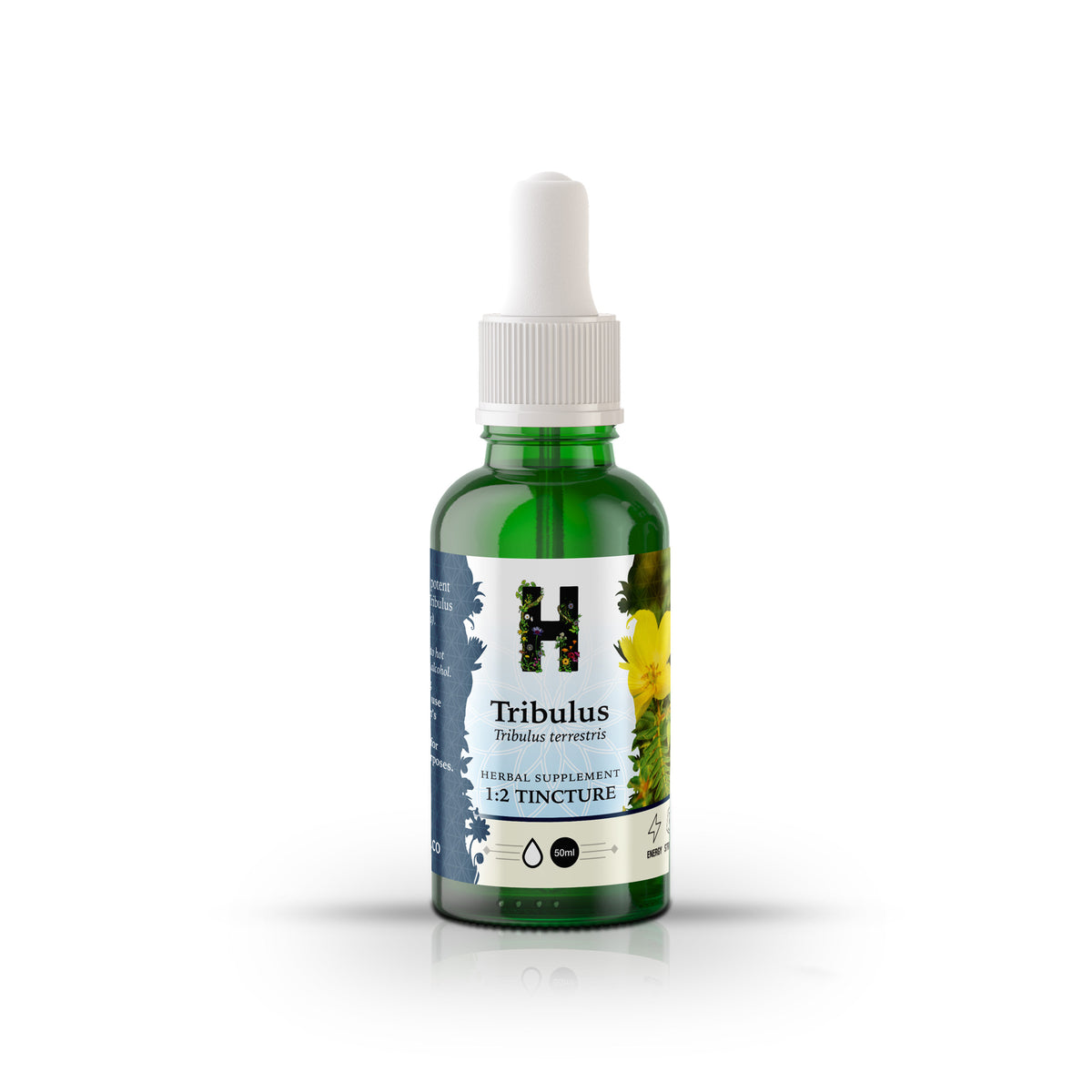
Botanical Concentrate
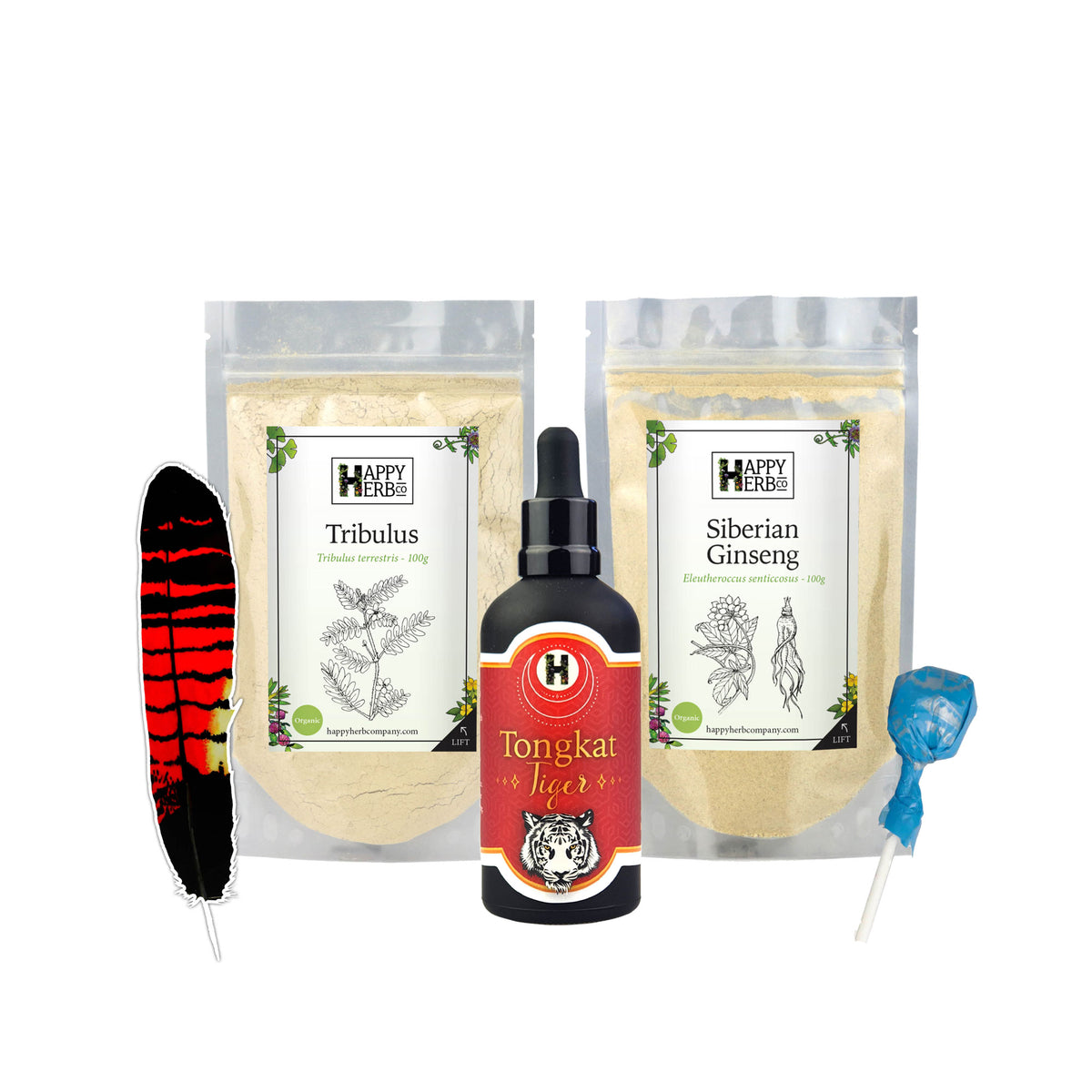
Bundle
A tincture, Siberian ginseng and tribulus powders, a sticker and a pop.

Party Pop
A peppermint lollipop with tongkat ali, cordyceps, tribulus and oatstraw.
FAQ
Tribulus (Tribulus terrestris) is a low, creeping annual of the caltrop family, native to the Mediterranean, Africa and Asia, also known as puncture vine. Its small, spiny fruit has been used in Chinese and Ayurvedic herbal traditions for thousands of years. Today Tribulus is taken as a liquid extract, or as a powder mixed with honey and hot water.
Tribulus is long associated with vitality, stamina and desire. In Ayurveda the fruit, known as Gokshura, is described as nourishing, in Chinese herbal tradition it is a herb for the kidneys, and Western herbalists class it as a tonic and a diuretic. Reviewers note that clinical trials are scarce, so we describe how it is used, not what it will do.
Tribulus is best known as a herb people reach for when they are in a demanding stretch of training or work and want to keep their vitality up. Most people take it daily for a few weeks at a time, as a liquid extract or as a powder in honey and hot water.
Mix 1 to 2 grams of Tribulus powder into a paste with honey, then add a cup of hot water and drink it as a tea. The same amount can be blended into a smoothie. Tribulus is also taken as a liquid extract in a little water, following the directions on the label.
No. Tribulus is naturally caffeine free, so it can be taken at any time of day. Its standing as a herb for vitality comes from its long history as a tonic in Ayurvedic and Chinese tradition, not from any stimulant such as caffeine.
The evidence says no. A 2014 systematic review of the published trials concluded that Tribulus is ineffective for increasing testosterone in humans, and that marketing claims to the contrary are unsubstantiated. A rise was seen in a limited number of animal studies, and in people only when Tribulus was taken as part of a combined supplement.
Avoid Tribulus if you are pregnant or breastfeeding. Do not combine it with hormonal medicines, and avoid it if you have a hormone-dependent cancer, such as breast, ovarian or testicular cancer. If you take medication or have a health condition, check with your health professional first.
Avoid if pregnant or breastfeeding. Avoid combining with hormonal drugs, or if you have hormone-dependent cancer (breast, ovarian, testicular).
As described in the monographs cited under Sources.