Epilobium Profile
Epilobium
Epilobium parviflorum
For male vitality, daily balance and long term ease.


Cart
Your cart is empty

Join us in our love of herbs
Epilobium Profile
Epilobium parviflorum
For male vitality, daily balance and long term ease.
Herbal Intelligence
Epilobium (Epilobium parviflorum) is a slender perennial of the evening primrose family, native to Europe and western Asia. Better known as Small Flowered Willow Herb, it has been part of European folk herbalism for centuries, and in the late twentieth century it became one of Central Europe's best-known tea herbs for men in later life.
The taste is mild, green and a little earthy, with a light astringency. Most people take Epilobium as a simple tea, one or two cups a day, and it is the herb our customers reach for when they want a steady daily cup for male vitality and long-term ease.
Willow herbs have been known to European herbalists since the sixteenth century. They appear in Leonhart Fuchs's German herbal of 1543 under the name Weiderich, as plants for wounds and bleeding(1).
Related species have histories of their own. In North America, Native American peoples used Fireweed (Epilobium angustifolium) on the skin, and in Russia its leaves were fermented into a drink known as Ivan tea(1).
The small-flowered species owes its modern standing to the Austrian herbalist Maria Treben. After she wrote about it in a 1978 booklet and again in her 1980 book, demand for the tea rose sharply in Austria, Germany and Poland, and pharmacies began to stock it(1). It is still sold across Central Europe today, mostly as a loose tea.
The aerial parts of Epilobium parviflorum contain ellagitannins such as oenothein A and B, along with flavonoids, phenolic acids and phytosterols(2). These constituents have been studied for their antioxidant activity and their influence on inflammatory and hormone-related pathways in the lower urinary tract(3). Research continues into inflammatory mediators, prostate cell metabolism and microbial balance.
In Western herbalism Epilobium is classed as an astringent and a tonic for the urinary system, and it is most often suggested to men from middle age onwards. It is commonly blended with Saw Palmetto, Nettle or Corn Silk.
People tend to make it a fixed part of the day: one cup in the morning and one before the evening meal, the pattern Maria Treben described(1), kept up over months.
The European Medicines Agency accepts Epilobium tea on the strength of its long-standing use, not clinical evidence: its assessment found no clinical studies to draw on(1). Laboratory research has centred on the tannin oenothein B, and reviewers agree that studies in people are still needed(2). So we describe how Epilobium is used, not what it will do.
Developed and reviewed by Laura Grace, Owner and Creative Director of Happy Herb Co, Herb Educator and Registered Ayurvedic Lifestyle Consultant · Clinically reviewed by Tamara Welsh, BSc, AdvDipWHM, ATMS, Clinical Herbalist
This profile is intended as a researched educational guide and does not replace the broader perspective of a herbal consultation.
In everyday life
Epilobium is used in three main ways.
Epilobium is usually taken daily over weeks or months, one or two cups a day.
The small-flowered one.
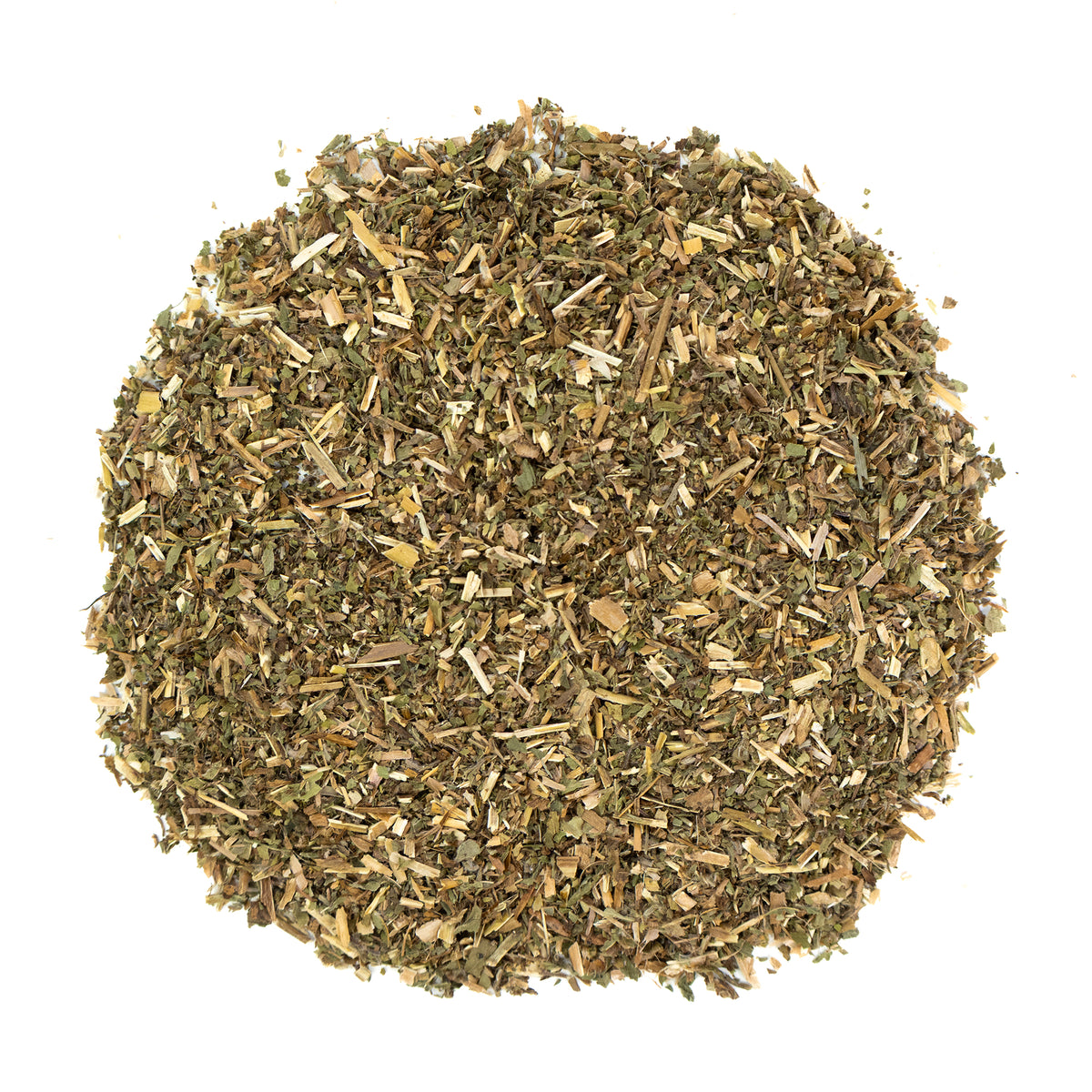
Look at the dried herb, slender stems and narrow leaves. Its grand cousin, rosebay willowherb, turns whole hillsides pink; this one is modest, and it is the one Austrian herbalists chose.
Steep a teaspoon or two for five minutes, a short steep for a mild, green cup, and drink it in the morning without hurry.
Sip slowly. The useful one is not always the showy one. Where might you be overlooking the quiet option?
Shop

Single Herb
FAQ
Epilobium (Epilobium parviflorum), also called Small Flowered Willow Herb, is a slender perennial of the evening primrose family, native to Europe and western Asia. It became one of Central Europe's best-known tea herbs in the late twentieth century, closely associated with men's health in later life. Today it is mostly taken as a tea.
Epilobium, also called willow herb, is long associated with the urinary system and with men's health in later life. Willow herbs have been known to European herbalists since the sixteenth century, and Western herbalists class Epilobium as an astringent. The European Medicines Agency accepts the tea on the strength of long-standing use and found no clinical studies, so we describe how it is used, not what it will do.
Epilobium is best known as a herb people reach for when they want a steady daily cup for male vitality and long-term ease. Most men take it daily for weeks or months: one cup in the morning and one before the evening meal, the pattern made popular by the Austrian herbalist Maria Treben.
Steep 1 to 2 teaspoons of dried Epilobium in a cup of just-boiled water, covered, for about 5 minutes, then strain. Most people drink one or two cups a day.
No. Epilobium is naturally caffeine free. The tea is mild, green and a little earthy, easy to drink plain, and it can be taken at any time of day, including the evening cup before dinner.
Not quite. Epilobium parviflorum, or Small Flowered Willow Herb, and Fireweed (Epilobium angustifolium) are close relatives in the same genus. Fireweed is the taller plant with large pink flower spikes, fermented in Russia as Ivan tea. The European Medicines Agency's willow herb monograph covers both species.
The European Medicines Agency's review of willow herb (Epilobium) tea did not raise poisoning as a concern: no side effects had been reported at the time of its assessment. It adds that willow herb should only be used after a doctor has ruled out serious conditions. If you take medication or have a health condition, check with your health professional first.
No formal safety studies of Epilobium in people have been published, so there is no established list of who should avoid it. If you are pregnant or breastfeeding, take medication or have a health condition, check with your health professional first.
Saw Palmetto berry and Epilobium, the Small Flowered Willow Herb, are the two herbs with a long tradition for men's urinary comfort in later life, and the European Medicines Agency accepts both for traditional use in that setting.
The trial evidence for Saw Palmetto is mixed, and large trials have not shown it to shrink the prostate. For Epilobium there are no clinical trials. Urinary symptoms in men over 50 need a GP's assessment first, since the causes vary. We describe how these herbs are used, not what they will do.
No formal safety studies of Epilobium in people have been published. If you are pregnant, breastfeeding or taking medication, check with your health professional first.
As described in the monographs cited under Sources.