Korean Ginseng Profile
Korean Ginseng
Panax ginseng
For vitality, physical endurance and whole body strength.


Cart
Your cart is empty

Join us in our love of herbs
Korean Ginseng Profile
Panax ginseng
For vitality, physical endurance and whole body strength.
Herbal Intelligence
Korean Ginseng (Panax ginseng) is a slow-growing perennial of the ivy family, native to the mountain forests of Korea and north-eastern China. Its pale, forked root is one of the best-known herbs in the world, and it has been taken as a tonic in East Asia for more than two thousand years.
The taste is earthy and bitter, with a faint sweetness. Most people take Korean Ginseng as a liquid extract or steep the sliced root as a tea, and it is the herb our customers reach for in the morning, through long and demanding stretches, when they want stamina and strength.
Ginseng has been used in Chinese herbal tradition for more than two thousand years. One of the earliest texts to describe it, the Shennong pharmacopoeia, was written around 196 CE(1). The name comes from a Chinese term meaning 'human root', after the forked shape of the root, and the botanical name Panax is from the Greek for 'all-healing'(1). In the Chinese materia medica it is a leading herb for building qi, the body's vital energy(2).
Korea has grown it for many centuries: raising Ginseng from seed is recorded there from 1122(1). The root is prepared in two ways. White ginseng is peeled and dried in the sun. Red ginseng is steamed and then dried, which turns it reddish-brown and lets it keep for years(1).
The Dutch brought Ginseng from Japan to Europe in 1610(1), where it stayed a rare and very expensive root into the early nineteenth century(2).
The compounds most studied in Korean Ginseng are the ginsenosides, a family of saponins found through the root and richest in its fine rootlets(2). The European Pharmacopoeia asks for at least 0.4 per cent of two of them, Rg1 and Rb1, in the dried root(2). Steaming changes the mix, so red and white ginseng differ in their ginsenosides(2). The root also contains polysaccharides and polyacetylenes(2).
In Western herbalism Korean Ginseng is classed as an adaptogen and a stimulant tonic: a root taken steadily over weeks, in times that ask a lot of body and mind. It is one of the more stimulating adaptogens, so it is kept for the morning.
People build it into the first part of the day through heavy workloads, hard training and the winter months, usually for several weeks, followed by a break.
Korean Ginseng is one of the most studied herbs. The European Medicines Agency accepts it as a traditional herbal medicine for fatigue and weakness, but finds the trials too varied and too small to give strong evidence for any one use(2). The US National Center for Complementary and Integrative Health notes that most trials have had fewer than 200 participants and run for less than three months(3). We describe how it is used, not what it will do.
Developed and reviewed by Laura Grace, Owner and Creative Director of Happy Herb Co, Herb Educator and Registered Ayurvedic Lifestyle Consultant · Clinically reviewed by Tamara Welsh, BSc, AdvDipWHM, ATMS, Clinical Herbalist
This profile is intended as a researched educational guide and does not replace the broader perspective of a herbal consultation.
In everyday life
Korean Ginseng root is taken in three main ways.
Korean Ginseng is a morning herb, as it may get in the way of sleep when taken late in the day. Most people take it daily for some weeks and then take a break.
Shaped like a person.
Look at a piece of the root. The whole root is forked like a human body, which is where its name comes from, and the finest wild roots have been prized above gold in Korea and China for two thousand years.
Steep a few thin slices in the morning for five to ten minutes. Ginseng is a daytime herb, taken in short courses with breaks.
Sip slowly. Wild ginseng takes decades to grow, and diggers once prayed before lifting one. What have you been given that took someone a long time to make?
In the Botanical Guides
Shop
Spagyric

Eden Healthfoods
Guarana, maca, yerba mate, green tea and ginseng in a whole-herb powder.
Spagyric
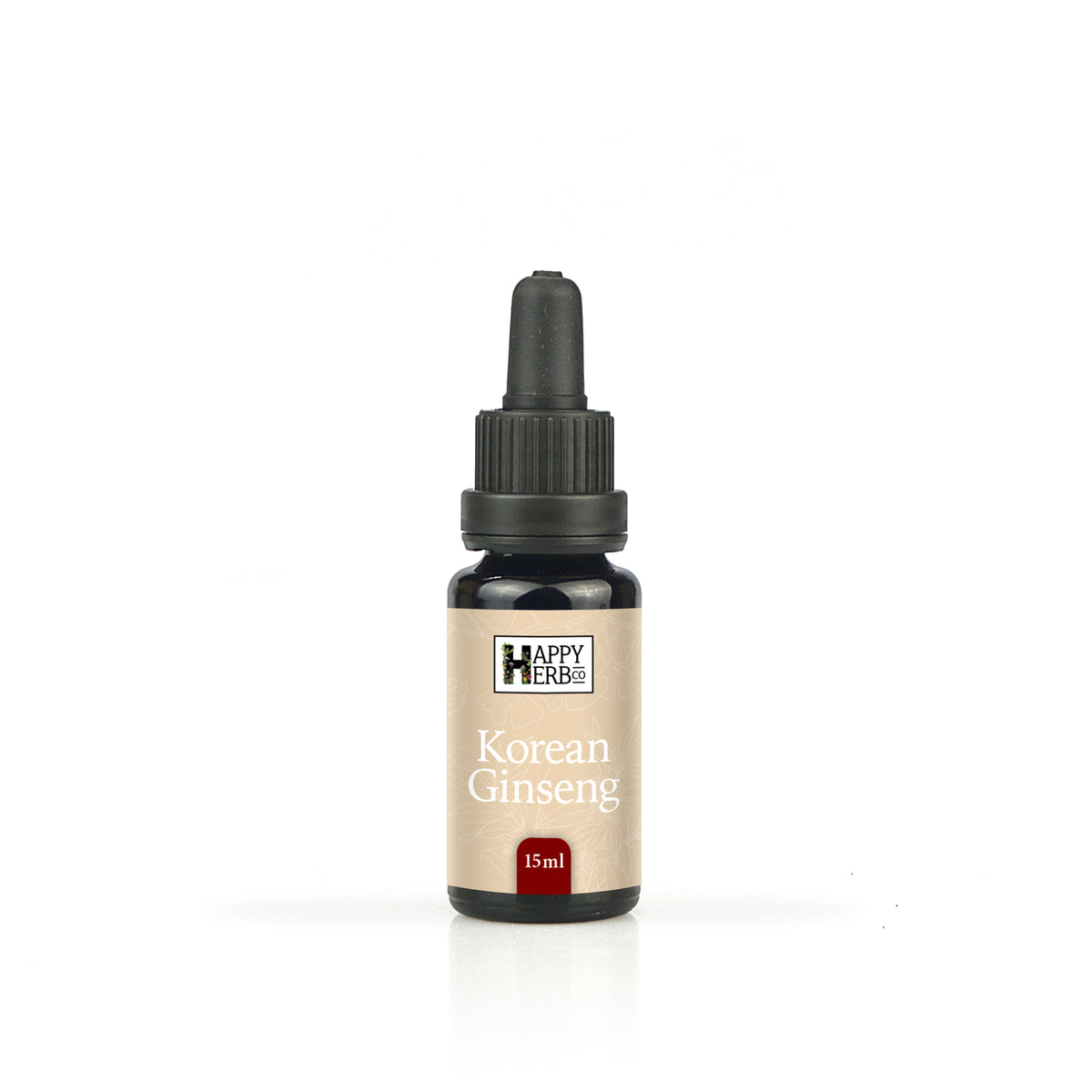
Korean ginseng, gymnema, coriander, cinnamon and dandelion in one spagyric.
FAQ
Korean Ginseng (Panax ginseng) is a slow-growing perennial native to the mountain forests of Korea and north-eastern China. Its forked root has been taken as a tonic in East Asia for more than two thousand years, and the name means 'human root'. Today Korean Ginseng is taken as a liquid extract, a tea or a powder.
Korean Ginseng is long associated with vitality, stamina and endurance. In Chinese and Korean herbal tradition the root is taken as a tonic to build qi, and Western herbalists class it as an adaptogen. The US National Center for Complementary and Integrative Health notes that most clinical trials have been small and short, so we describe how it is used, not what it will do.
Korean Ginseng is best known as a herb people reach for when they are in a long, demanding stretch and want stamina. Most people take it in the morning, daily for several weeks at a time, and then take a break. It is best avoided late in the day, as it may get in the way of sleep.
Korean Ginseng is most often taken as a liquid extract in a little water, following the directions on the label. To make a tea, steep 1 to 2 grams of sliced dried root, a few thin slices, in a cup of just-boiled water for 5 to 10 minutes. Take it in the morning, not near bedtime.
No. Korean Ginseng is naturally caffeine free. Herbalists still class it as a stimulant, and the US National Center for Complementary and Integrative Health lists trouble sleeping as its most common side effect, so most people take Korean Ginseng in the morning and avoid it near bedtime.
The US National Center for Complementary and Integrative Health states that short-term use of Korean Ginseng by mouth, up to six months in recommended amounts, appears to be safe for most people, and that questions remain about long-term use. The European Medicines Agency works on a limit of three months. Many people take it daily for some weeks, then take a break.
Korean Ginseng may cause trouble sleeping, so avoid it late in the day. Avoid it in pregnancy and while breastfeeding, and with high blood pressure, bleeding disorders or hyperactivity. Use caution with diuretic, antidepressant, anticoagulant, anticonvulsant, cardiac glycoside, calcium channel blocker and diabetes medicines, as it may lower blood sugar. The US NCCIH does not recommend it for children. If you take medication or have a health condition, check with your health professional first.
Korean Ginseng is Panax ginseng, the original ginseng of Chinese and Korean tradition and the one most of the research is about. Its characteristic compounds are ginsenosides, and it is considered the most stimulating of the family, taken in the morning and for stamina. Red and white Korean Ginseng are the same root, steamed or simply dried.
American Ginseng (Panax quinquefolius) is a true ginseng from the same genus, with a gentler, cooler reputation in Chinese medicine. Siberian Ginseng (Eleutherococcus senticosus) is not a Panax at all: a different plant from the same wider family, given the name for its similar reputation as an adaptogen, with eleutherosides rather than ginsenosides and a steadier, less stimulating character.
Korean Ginseng (Panax ginseng) is the root people reach for during long, demanding stretches rather than for a quick lift. It has one of the longest records of use of any herb, and it is taken in the morning, daily, for a few weeks at a time with breaks between. Its profile covers the chemistry, the traditional use and the precautions.
May cause trouble sleeping, avoid near bedtime. Avoid if pregnant or breastfeeding. Not suitable for people with high blood pressure, and traditionally avoided in people with bleeding disorders or hyperactivity. Cautioned with prescription medications including diuretic, antidepressant, anticoagulant, anticonvulsant, cardiac glycoside and calcium channel blocker drugs. May lower blood sugar. If you have diabetes or take diabetes medication, check with your health professional first.
As described in the monographs cited under Sources.