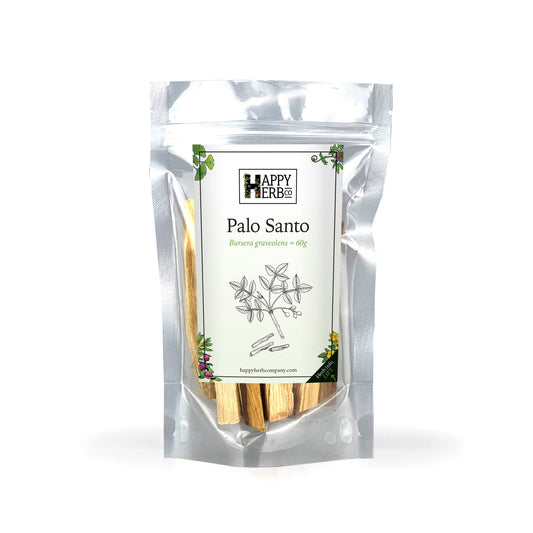
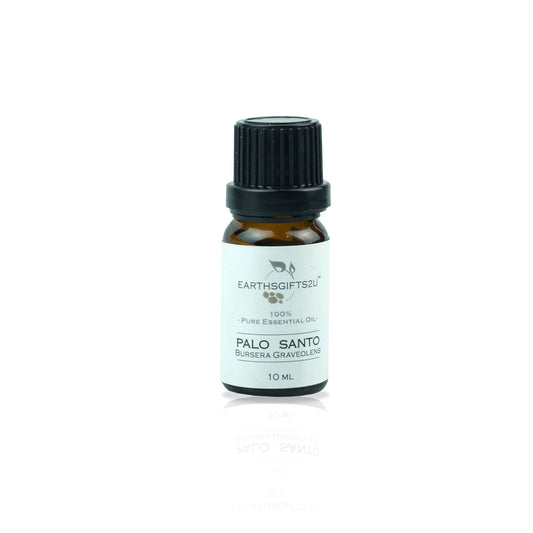
Palo Santo (Bursera graveolens) is a fragrant tree of the frankincense family, native to the dry forests from southern Mexico to northern Peru. Its name is Spanish for holy wood, and in Ecuador and Peru the wood is burned for its sweet smoke in ceremony and in daily life.
The scent is woody and sweet with a citrus edge. Palo Santo is not a tea herb: most people burn a stick, light an incense or diffuse the essential oil. It is the wood our customers reach for when they want to clear a space, begin a ritual or settle into meditation.
Cultural use
Palo Santo grows in tropical dry forests from Mexico's Yucatán Peninsula south to Peru, and on the Galápagos Islands. It is a close relative of the trees that give frankincense and myrrh, and its Spanish name means holy wood.
Its ceremonial use is a living practice. Among the Saraguro, a Kichwa-speaking people of southern Ecuador, healers known as yachakkuna include Palo Santo in a cargado, a preparation of plants in water or cane spirit that is blown over a person after a ritual cleansing. In the region's markets the wood is sold for incense and for bathing.
In Peru the tree grows in the dry hill forests of Piura. The government lists it as critically endangered, forbids the felling of living trees and permits only the collection of wood that has fallen or died naturally. Across its whole range, the IUCN Red List assessed the species in 2019 as Least Concern.
Modern herbal use
Palo Santo sits outside the usual herbal categories. It is not taken as a tea or an extract. It is an aromatic: a wood valued for its scent. Most people light a stick at a threshold moment, such as moving into a new home, opening or closing the day, or before meditation and ceremony. The sticks are now sold as far away as Europe, in kits for cleansing a space.
It is worth knowing which wood you are buying. An unrelated tree from Argentina, Bolivia, Brazil and Paraguay, Bulnesia sarmientoi, is also sold as palo santo. The IUCN lists that species as Endangered, and its trade is controlled under CITES. Our Palo Santo is Bursera graveolens, gathered from naturally fallen wood.
Research on Palo Santo is at an early stage. The published work is on the chemistry of the oil, and a 2024 study notes there is no data on the pressure that commercial demand puts on wild trees. So we describe how it is used, not what it will do.
How it's used
Palo Santo is used in three main ways, all of them for its scent.
Burning a stick. Hold one end in a flame for about 30 seconds, then blow it out so the tip smoulders. Carry it through the room or rest it in a fireproof dish, with a window open. It goes out by itself, and one stick can be relit many times.
Incense. Lit in the same way and left to burn down in a holder, away from curtains and draughts.
Essential oil. Add a few drops to a diffuser, following the maker's directions. The oil is for scenting a room, not for swallowing.
Palo Santo is used now and then, when the moment calls for it. It is not eaten, brewed or taken as a tea.


 Sold out