Pine Pollen Profile
Pine Pollen
Pinus massoniana
For men's vitality and stamina.


Cart
Your cart is empty

Join us in our love of herbs
Pine Pollen Profile
Pinus massoniana
For men's vitality and stamina.
Herbal Intelligence
Pine Pollen (Pinus massoniana) is the fine golden pollen of the Masson Pine, a tree native to China. Gathered from the male catkins each spring, it has been used in China as both a food and a medicine since at least the Tang dynasty, and is known there as Songhuafen.
The powder is fine, pale yellow and mild in flavour. Most people take Pine Pollen as a liquid extract or as a powder stirred into a drink, and it is the herb our customers reach for in long, demanding seasons, when they want a daily tonic for stamina and vitality.
Pine Pollen comes mainly from the Masson Pine, Pinus massoniana, and from a second Chinese pine, Pinus tabuliformis(1). In China it is called Songhuafen or Songhuang, and it was first recorded in the Xin Xiu Ben Cao, a herbal of the Tang dynasty(1).
Later writers kept it in view. Li Shizhen described it in his Compendium of Materia Medica as a substance that nourishes the heart and lungs(1). In Chinese herbal tradition it is taken to replenish qi, the body's vital energy, and it is linked with long life(1).
It has always been two things at once: a food and a medicine(1). The dry, fine, yellow powder is taken by mouth and is also applied to the skin, a use that carries on in Chinese clinics today(1).
Pine Pollen contains proteins, amino acids, vitamins, minerals, enzymes, fats, flavonoids and polysaccharides(1, 2). Laboratory studies have looked closely at its polysaccharides(2). A 1971 study also reported testosterone, epitestosterone and androstenedione in the pollen of Scots pine, a different species(3). How any of this relates to the powder or extract a person takes has not been established.
Pine Pollen is a newcomer to Western herbalism, where it is classed as a nutritive tonic: something taken daily over weeks to build a person up. It is often spoken of alongside the adaptogens, though it is not formally counted as one.
People take it through long stretches of work or training, in midlife, and when stamina feels low. It is popular with men, and much of its modern fame rests on the idea that it raises testosterone.
That idea runs ahead of the evidence. A 2020 analysis found 239 publications on Pine Pollen, most of them laboratory studies. Only 37 were clinical trials, few of them randomised and many of the powder applied to the skin, and the authors could not draw firm conclusions on its effects or safety(1). So we describe how it is used, not what it will do.
Developed and reviewed by Laura Grace, Owner and Creative Director of Happy Herb Co, Herb Educator and Registered Ayurvedic Lifestyle Consultant · Clinically reviewed by Tamara Welsh, BSc, AdvDipWHM, ATMS, Clinical Herbalist
This profile is intended as a researched educational guide and does not replace the broader perspective of a herbal consultation.
In everyday life
Pine Pollen is taken in two main ways.
Pine Pollen is usually taken daily for several weeks at a time, not now and then.
Spring, gathered by hand.
Tip a little of the pollen onto a dark plate and look at it, a fine gold dust. It is shaken from the catkins of Masson pines in the mountains of China during a few days each spring.
Stir the powder into milk, juice or a smoothie in the morning, or take the tincture in water. Pine pollen is taken daily for a few weeks at a time.
Sip slowly. A tree releases a cloud of this each spring so that one grain may land. What are you willing to scatter widely for the sake of one thing taking root?
In the Botanical Guides
Shop
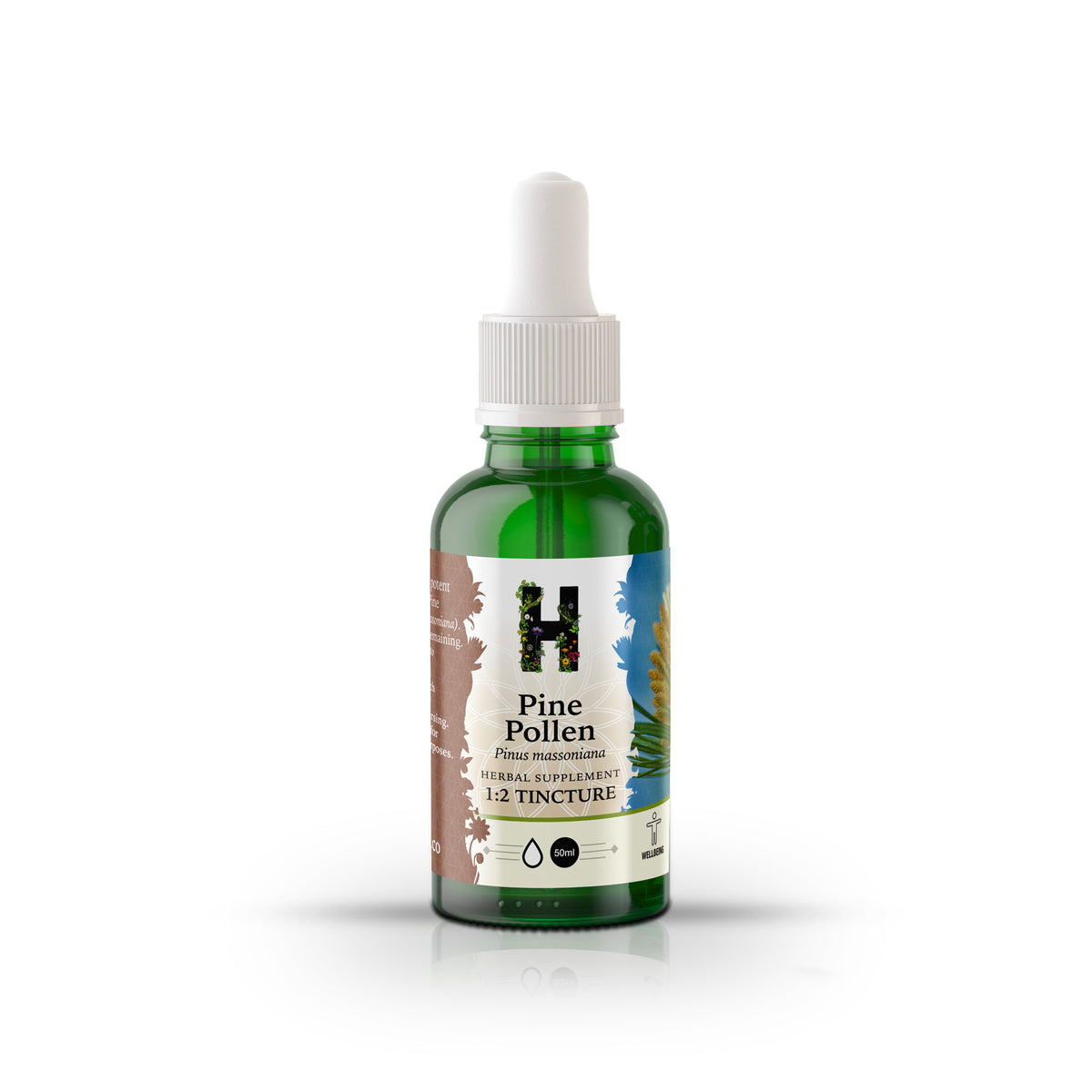
Botanical Concentrate
For hormonal vitality, physical endurance and daily nourishment.
FAQ
Pine Pollen is the fine golden pollen of pine trees, chiefly the Masson Pine (Pinus massoniana) of China, gathered from the male catkins each spring. Known in China as Songhuafen, it has been used there as both a food and a medicine since at least the Tang dynasty. Today Pine Pollen is taken as a liquid extract or a powder.
Pine Pollen is long associated with vitality and stamina. In Chinese herbal tradition it is taken to replenish qi and is linked with long life, and Western herbalists class it as a nutritive tonic. A 2020 analysis of the research found few high-quality trials in people and could not draw firm conclusions, so we describe how it is used, not what it will do.
Pine Pollen is best known as a herb people reach for when they are in a long, demanding stretch and want a daily tonic. Most people take it each morning for several weeks at a time, as a liquid extract in a little water or as a powder stirred into a drink.
Pine Pollen is taken as a liquid extract in a little water or juice, or as a powder stirred into water, milk or a smoothie. Follow the directions on the label for the amount. Most people take Pine Pollen daily for several weeks at a time, not now and then.
No. Pine Pollen is naturally caffeine free. It is the pollen of a pine tree, and it is taken as a daily tonic over weeks, not for a quick lift. That makes it easy to take alongside your usual tea or coffee, or in place of them.
Pine Pollen is widely sold on that idea, but the evidence is thin. A 1971 study reported testosterone and related compounds in the pollen of Scots pine. A 2020 analysis of 239 publications on Pine Pollen, however, lists no trial of hormone levels among its most-studied uses in people, which were mainly skin applications. We do not describe Pine Pollen as a way to raise testosterone.
People with a known allergy to tree pollen should be cautious with Pine Pollen, or speak with a herbal practitioner first. Because it is regarded as hormone-active, anyone with a hormone-sensitive condition, such as certain cancers, should use it only under professional guidance. If you take medication or have a health condition, check with your health professional first.
Individuals with known tree pollen allergies should proceed with caution or consult an herbal practitioner. As a hormone-active substance, those with hormone-sensitive conditions (like certain cancers) should use it under professional guidance.