Suma Profile
Suma
Pfaffia paniculata
For whole body vitality, restoration and physical endurance.


Cart
Your cart is empty

Join us in our love of herbs
Suma Profile
Pfaffia paniculata
For whole body vitality, restoration and physical endurance.
Herbal Intelligence
Suma (Pfaffia paniculata) is a sprawling vine native to the Amazon basin, grown for its large, pale root. In Brazil it is known as para tudo, 'for everything', and elsewhere as Brazilian ginseng.
The taste is mild, earthy and slightly sweet. Most people take Suma as a powder stirred into a smoothie, or simmered as a tea, and it is the herb our customers reach for in long, busy stretches, when they want steady stamina for work, training or recovery.
Suma is the root of a rainforest vine, and in Brazil it goes by several names: suma, corango and paratudo, 'for everything'(1). The last says how broadly the root has been used in folk practice, as an everyday tonic.
It is also called Brazilian ginseng. The two plants are not related: the name was given because Pfaffia roots are commonly used for the same purposes as ginseng(1). Several Pfaffia species share the name, and Suma is the one most used in commercial preparations in Brazil(1).
A survey of Brazilian folk-medicine books counts Pfaffia paniculata among the native plants used in ways that resemble an adaptogen, in times of stress and for physical performance(2). Botanists now place the plant in the genus Hebanthe, though it is still sold under the older name.
Suma roots contain nortriterpenoid saponins known as pfaffosides, along with pfaffic acid and related triterpenoids, and ecdysteroid-type compounds such as 20-hydroxyecdysone(3, 6). In the laboratory, root extracts have been studied for their interactions with inflammatory signalling and oxidative stress pathways(4, 5), and standardised extracts for antimicrobial and cytotoxic activity in vitro(5).
In Western herbalism Suma is classed as an adaptogen: a root taken steadily over weeks, in times that ask a lot of the body. It is often blended with Maca, Ashwagandha or Cacao.
People build it into the morning: a spoonful in a smoothie before work or training, or a cup of the simmered root. It is taken daily through a busy season, a block of training or a period of rebuilding, and then rested.
The research is thin. Laboratory and animal studies have explored the root's saponins and other compounds(4, 5). Human trials are few, and a survey of Brazilian plants with adaptogen-like uses found that clinical studies are what is most lacking(2). So we describe how it is used, not what it will do.
Clinically reviewed by Tamara Welsh, BSc, AdvDipWHM, ATMS, Clinical Herbalist ·
This profile is intended as a researched educational guide and does not replace the broader perspective of a herbal consultation.
★★★★★
4.7 out of 5, from 3 reviews
I add this to my daily morning smoothie. I find it supports me feeling light, soft and feminine
Good stuff :)
De l'énrgie physique mais aussi mentale ! produit multifonctions ! je recommande !
Dear Paola,
Thank you very much for your reviews. Glad to hear you are enjoying your herbs.
Have a happy & health day!
Cheers,
Happy Herb Co
In everyday life
Suma root is taken in three main ways.
Most people take Suma in the morning or before activity, daily for a few weeks at a time.
For everything, said the Amazon.
Hold a piece of the root. In Brazil it is called para toda, for everything, and the peoples of the Amazon basin have used it for generations as an all-round daily root.
Simmer a teaspoon or two for ten minutes and blend it with cacao, or stir the powder into a morning smoothie. Take it before activity rather than after.
Sip slowly. For everything is a big claim, and the people who made it simply meant they used it often. What do you reach for most often, and why?
In the Botanical Guides
Shop


Single Herb

Medicine Garden
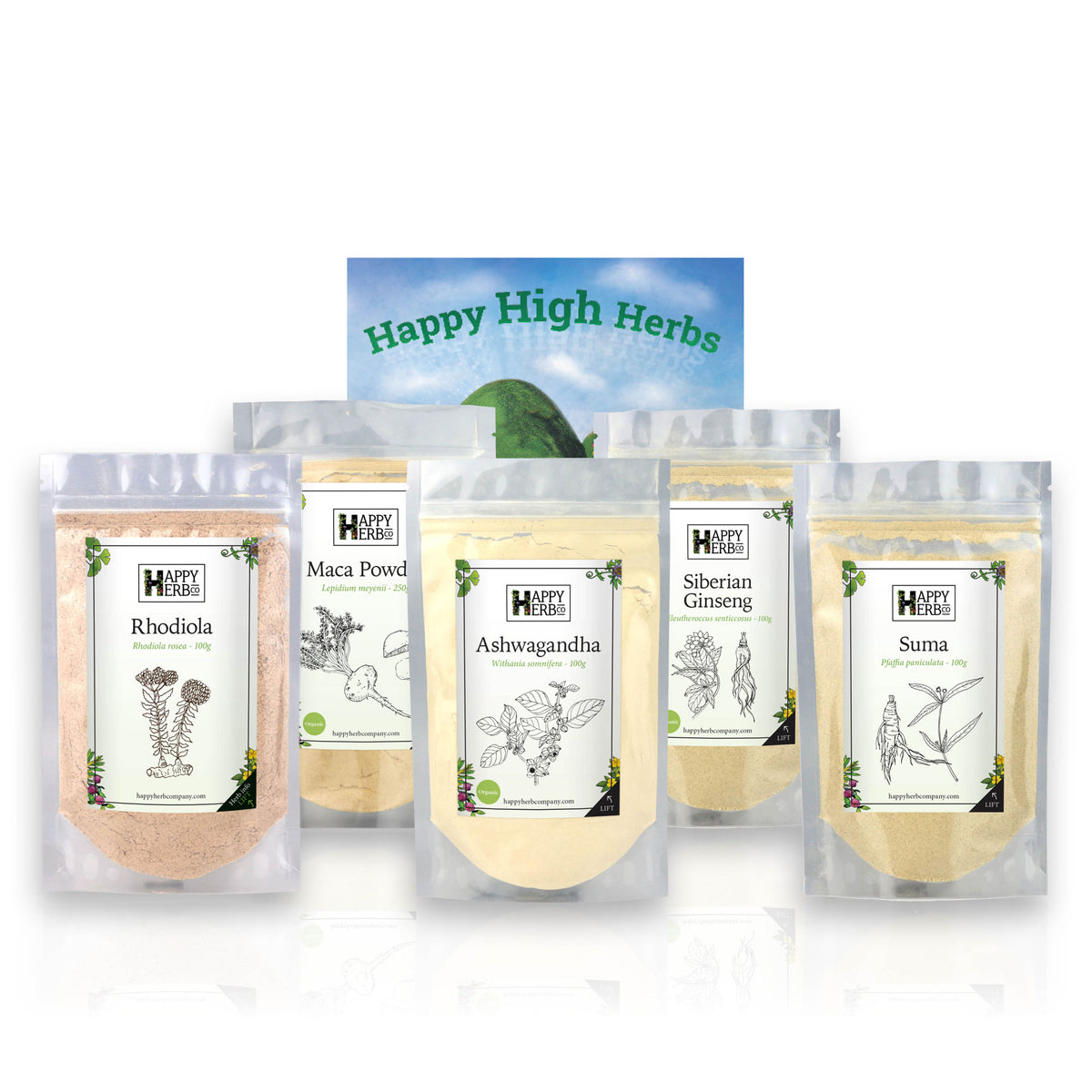
Bundle
Rhodiola, maca, mucuna, Siberian ginseng and suma powders, plus a book.
FAQ
Suma (Pfaffia paniculata) is the root of a sprawling vine native to the Amazon basin. In Brazil it is known as para tudo, 'for everything', and elsewhere as Brazilian ginseng, though it is not related to true ginseng. Today Suma is taken as a powder in smoothies, simmered as a tea, or taken as a liquid extract.
Suma is long associated with stamina and vitality. In Brazilian folk practice the root is an everyday tonic, known as para tudo, 'for everything', and Western herbalists class it as an adaptogen. Research so far is mostly laboratory and animal work, with few human trials, so we describe how it is used, not what it will do.
Suma is best known as a herb people reach for when they want steady stamina through a long, demanding stretch of work, training or recovery. Most people take it in the morning or before activity, daily for a few weeks at a time, as a powder in a smoothie or as a simmered tea.
Simmer 1 to 2 teaspoons of Suma root in a cup of water for 10 minutes, then strain, or stir the powder into a smoothie, juice or hot chocolate. The flavour is mild and earthy. Suma is also taken as a liquid extract, following the directions on the label.
No. Suma is naturally caffeine free. It is the root of a South American vine in the amaranth family. Some blends pair Suma with Kola Nut, Guarana or Cacao, which do contain caffeine, so check the ingredients if you are avoiding it.
No. Suma (Pfaffia paniculata) is a South American vine of the amaranth family, while true ginseng is a Panax species from a different plant family. Suma is called Brazilian ginseng because Pfaffia roots are commonly used for the same purposes as ginseng. The two plants are not related.
Suma may have oestrogen-like effects, so do not use it if you have an oestrogen-positive cancer. If you take medication or have a health condition, check with your health professional first.
It may have oestrogen-like effects. Do not use with oestrogen-positive cancers.
This herb has not been studied enough for its actions to be defined. What we know of it comes from tradition and the sources below.