Damiana Profile
Damiana
Turnera diffusa
For mood uplift and sensual presence.


Cart
Your cart is empty

Join us in our love of herbs
Damiana Profile
Turnera diffusa
For mood uplift and sensual presence.
Herbal Intelligence
Damiana (Turnera diffusa) is a small, aromatic shrub native to Mexico, Central America and the Caribbean. Its dried leaf has been brewed and shared for centuries, and it has long been known as a plant of love, ease and good company.
The flavour is aromatic and a little sweet, with a soft bitterness. Most people enjoy Damiana as a tea or a liquid extract, and it is a classic leaf in milled herb blends. It is the herb our customers reach for when the day is done and it is time to unwind, connect and enjoy the moment.

Damiana grows wild across Mexico, and its recorded story starts there. The Maya knew the plant as mizibcoc, and in 1699 the Spanish missionary Juan María de Salvatierra wrote of people in Mexico preparing a sweetened Damiana drink, valued for its reputation in love(1).
That reputation followed it north. When Damiana reached American pharmacies in the 1870s it was given the botanical name Turnera aphrodisiaca(1, 2). Botanists now call it Turnera diffusa, but the old name says plenty about how the plant was seen.
In Mexico today Damiana is still steeped as an everyday tea, and in Baja California it flavours a traditional sweet liqueur(2). Across these traditions it is a plant for company: shared at the table, in courtship and in ceremony, and linked in folklore with romance and vivid dreaming.
The dried leaves of Damiana (Turnera diffusa) contain several groups of plant compounds, including flavonoids such as apigenin, volatile oils, cyanogenic glycosides, and alkaloids such as damianin(3). In the laboratory these compounds are studied for antioxidant activity and for their effects on mood pathways, smooth-muscle tone and metabolic processes(3).
In Western herbalism Damiana is classed as a nervine: one of the aromatic herbs chosen for ease and a lighter mood. It has an entry in the British Herbal Pharmacopoeia(5), and herbalists often describe it as relaxing and gently uplifting at once, which is why it appears in so many evening teas, social blends and formulas made for intimacy. Older Western herbals, among them King's American Dispensatory of 1898, also wrote of Damiana as a herb for the kidneys and bladder, and some herbalists still think of it as a kidney tonic(6).
For many people Damiana is part of habit shifting: a pot of tea in place of the evening glass of wine, or a quieter ritual at the end of the day. It suits the hours after work, time with a partner, and gatherings where you want to feel relaxed, chatty and present.
Research into Damiana is still at an early stage. Most of what is known comes from tradition and long use rather than clinical trials(2), so we describe how it is used, not what it will do.
Developed and reviewed by Laura Grace, Owner and Creative Director of Happy Herb Co, Herb Educator and Registered Ayurvedic Lifestyle Consultant · Clinically reviewed by Tamara Welsh, BSc, AdvDipWHM, ATMS, Clinical Herbalist
This profile is intended as a researched educational guide and does not replace the broader perspective of a herbal consultation.
★★★★★
4.8 out of 5, from 157 reviews
Love this product. Thank you
I just bought a new lot but it's making me cough so im.glad I have a bit of this one left Perfect as always.
Damiana is my go to, that's why I took the plunge and got the large amount this time but this batch is really harsh. It's making me cough through the night quit a bit too which is also unusual. I wasn't sure it was the Damiana at first so I tried my other two on their own but they were both great as always. So I'm a bit bummed that this lot is unsuitable for smoking but I can make a tea out of it so thank goodness for that! 👍🏾!!
Acquired the 90g in the foil lined paper bag, cracked it open it was so aromatically fresh and bright, I don't think it could have been prepared any better as it was still dried properly. Wonderful gift thanks.
The best mixture to mull and is alright to smoke
In everyday life
Damiana leaf is enjoyed in three main ways.
Damiana also infuses well into wine, spirits and honey, the idea behind the traditional Mexican liqueur.
Make room for pleasure.
Take a little damiana leaf between your fingers. Notice its aromatic scent, bright and a little bitter, and its soft, earthy character. A herb with a long tradition of sensuality, damiana invites you to remember life's simpler pleasures.
Prepare a cup of damiana tea. Find a comfortable place, feel the air against your skin and put aside everything that needs doing.
Sip slowly. What brings you pleasure, simply for the joy of it? Let this moment be one of those things.
In the Botanical Guides
Shop
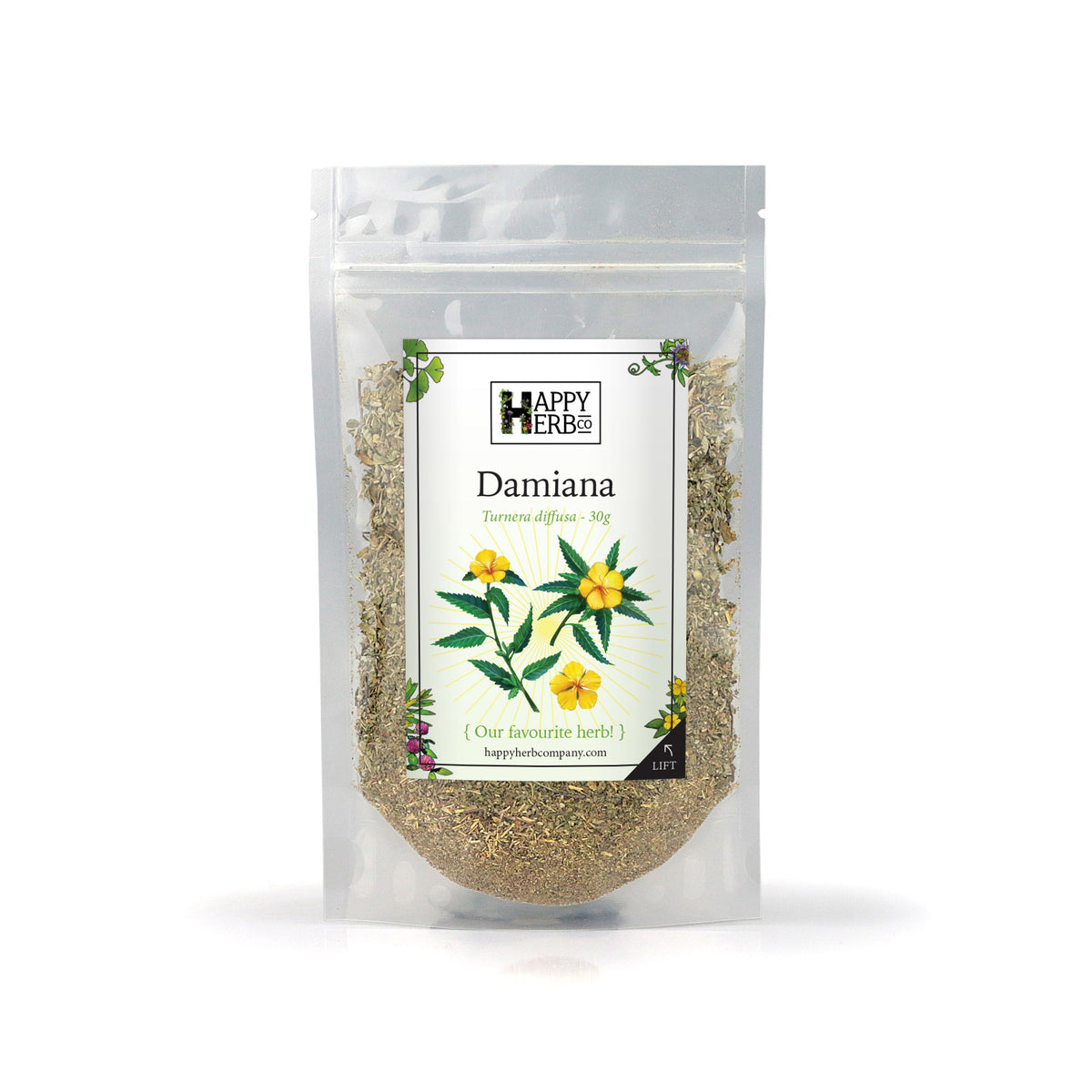
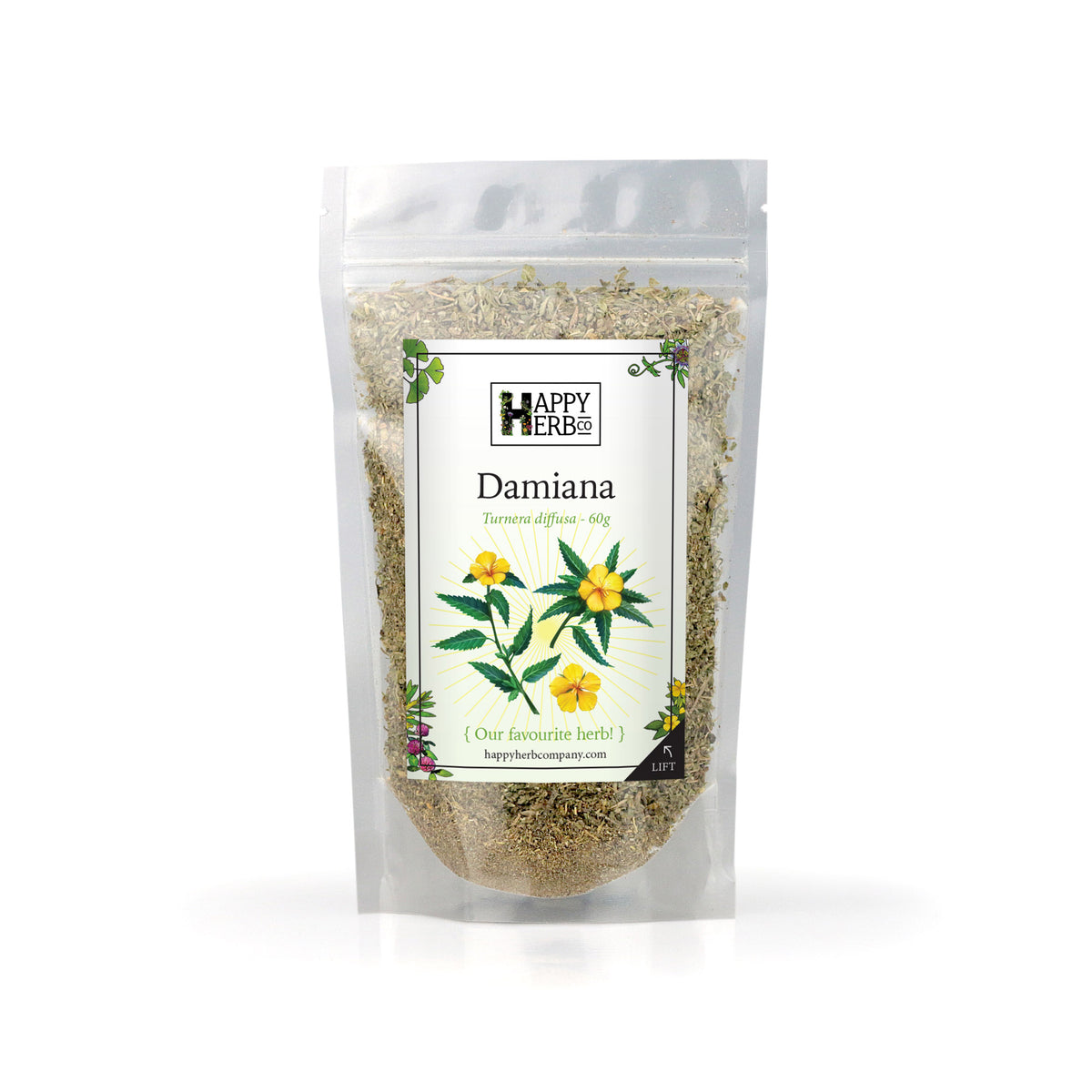
Single Herb

Botanical Concentrate

Botanical Concentrate

Spagyric
FAQ
Damiana (Turnera diffusa) is a small, aromatic shrub native to Mexico, Central America and the Caribbean. Its dried leaf has been brewed and shared for centuries, and folklore has long linked it with love, ease and good company. Today Damiana is enjoyed as a tea, as a liquid extract and in milled herb blends.
Damiana is long associated with relaxation, mood and love. In Mexico the leaf is steeped as an everyday tea and shared in company, and Western herbalists class Damiana as a nervine, chosen for ease and a lighter mood. Research into Damiana is still at an early stage, so we describe how it is used, not what it will do.
Damiana is best known as a herb people reach for when the day is done and they want to unwind. Most people have a cup in the evening or at social moments: after work, with a partner, or at a gathering, often in place of an alcoholic drink. For many it is part of a habit-shifting ritual at the end of the day.
Steep 1 to 2 teaspoons of dried Damiana leaf in a cup of just-boiled water, covered, for 10 minutes, then strain. Add honey, mint, rose or cinnamon to taste.
Possibly a little. Damiana is not known as a caffeine herb and is usually enjoyed as an evening tea, but it may not be entirely caffeine free. A 2014 review of the genus lists caffeine among the compounds found in Turnera plants, and the USDA's phytochemical database records it in Damiana leaf without giving an amount. If you avoid caffeine strictly, keep that in mind.
Yes. Damiana leaf has a long history of being smoked, on its own or blended with other herbs, and it is one of the classic leaves in our milled herb blends. People choose it for its soft, aromatic character and its gentle, even smoulder.
Inhaling smoke is harmful; we describe how the herb is used, we do not suggest it. Many people prefer to enjoy Damiana as a tea.
Damiana is not recommended during pregnancy or breastfeeding. Long-term heavy use may affect iron absorption, so go lightly if you are low in iron. If you take medication or have a health condition, check with your health professional first.
Not recommended during pregnancy or breastfeeding. Long-term heavy use may affect iron absorption, so go lightly if you are low in iron. If you take medication or have a health condition, check with your health professional first.
As described in the monographs cited under Sources.