Blue Lily Profile
Blue Lily
Nymphaea caerulea
For ceremonial use, dream work and deep relaxation.

Cart
Your cart is empty

Join us in our love of herbs
Blue Lily Profile
Nymphaea caerulea
For ceremonial use, dream work and deep relaxation.
Herbal Intelligence
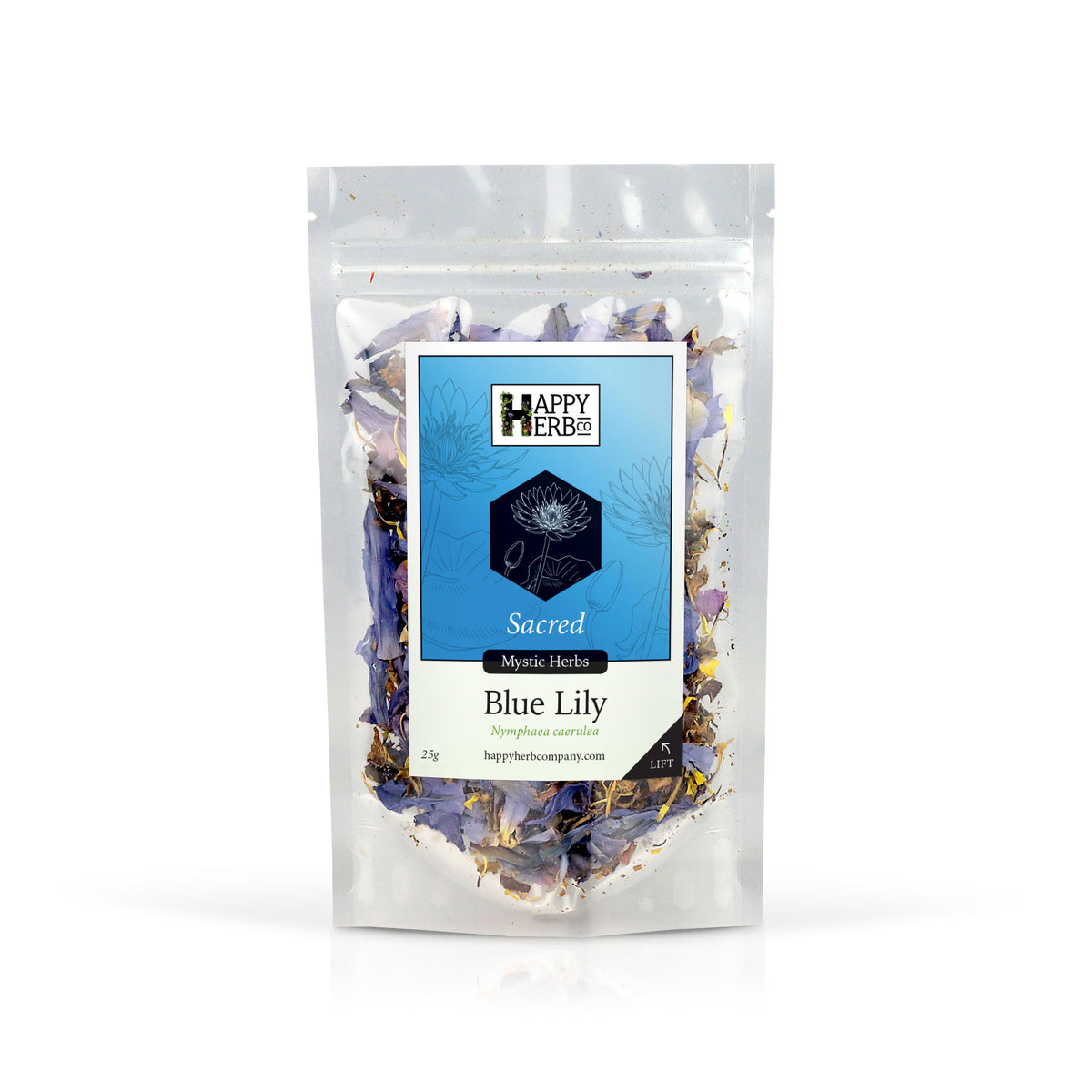
Blue Lily (Nymphaea caerulea) is a water lily native to the still waters of the Nile and eastern Africa, also known as Blue Lotus. Its sky-blue flowers were grown, painted and revered in ancient Egypt for thousands of years.
The taste is floral and delicate, with a light bitterness. Most people enjoy Blue Lily as a tea or a liquid extract, and it is a favourite flower in milled herb blends. It is the herb our customers reach for late in the evening, when they want deep relaxation, a sense of ceremony or a night of vivid dreams.
Blue Lily grows wild in lakes, pools and slow rivers from Egypt to South Africa(1). In ancient Egypt it was grown in garden pools and offered to the gods and to the dead, and its flowers appear on monuments, murals, pottery and furniture(1). Monarchs and priests were laid to rest with wreaths of its petals(1). It appears in tomb frescoes and in the Book of the Dead, always in a ritual setting(2).
Despite its other name, Blue Lotus, the plant is a water lily and not a true lotus. Botanists now call it Nymphaea nouchali var. caerulea; caerulea refers to the sky blue of the flowers, which open each morning and close by late afternoon(1).
Today the dried flowers are steeped as a tea or taken as a liquid extract, most often in the evening or as part of ceremony.
Blue Lily flowers (Nymphaea caerulea) contain a variety of compounds, including aporphine-type alkaloids such as nuciferine and apomorphine, along with flavonoids and other phenolic molecules(3). In the laboratory these compounds are studied for their action on dopamine and serotonin signalling and for their antioxidant properties(4).
In modern herbal practice Blue Lily is classed as a relaxing nervine: a flower chosen for unwinding, for quiet company and for the hour before sleep. It is also popular with people who meditate or keep a dream journal.
For many people Blue Lily is part of habit shifting: a pot of tea, or a few drops of extract in a mocktail, in place of the evening drink. It suits slow nights and unhurried conversation.
Blue Lily has hardly been studied in people. A 2023 chemical survey of Blue Lily extracts found little or none of the two alkaloids often credited for its effects, apomorphine and nuciferine, and noted that safety data on the plant are limited(6). Most of what is known comes from long use, so we describe how it is used, not what it will do.
Developed and reviewed by Laura Grace, Owner and Creative Director of Happy Herb Co, Herb Educator and Registered Ayurvedic Lifestyle Consultant · Clinically reviewed by Tamara Welsh, BSc, AdvDipWHM, ATMS, Clinical Herbalist
This profile is intended as a researched educational guide and does not replace the broader perspective of a herbal consultation.
★★★★★
4.6 out of 5, from 33 reviews
nice to relax with
On the milder side but very enjoyable nonetheless
This is my favourite and reminds me of blue lagoon (if you know, you know lol). Secret is layering. I do a ml every hour on the hour for 4 hours. Then repeat on following day (it's my weekend ritual and during full moon when my left shoulder gets pulled). Bliss can be achieved. Resin is good too ❤️
Helps boost my mood and make me feel calm, would give 5 stars but I find it have to use large amounts and have gone through it quick
The flavour of this tincture is beautiful! Alcohol extractions are a super effective extraction method, but often taste harsh especially if you’re avoiding/cutting down on alcohol, but the mix of this with rice malt syrup and vanilla etc is really yummy. Mixes beautifully into a tea or iced drink, and still pleasant to take sublingually. The effects are lovely; super soothing and with a slight uplift, great for relaxing or honing into the body and feelings. I have a super active brain during intimate moments in particular, and this tincture helps me to focus on the moment and enjoy more
In everyday life
Blue Lily flowers are enjoyed in three main ways.
Blue Lily can also be infused in wine: cover 10 grams of flowers well, as they swell, and soak for a day to two weeks. Most people keep Blue Lily for evenings.
The art of opening.
Take a few blue lily petals in your hands. Notice their delicate texture and subtle fragrance. Imagine this flower rising from still water, opening its petals to greet the morning sun.
Prepare a cup of blue lily tea and find somewhere quiet to sit. As the petals steep, consider what in your own life might be waiting to unfold.
Sip slowly. Not everything needs to be hurried. Some things bloom in their own time.
In the Botanical Guides
Shop

Botanical Concentrate

Spagyric

Botanical Concentrate

Mystic Herb
FAQ
Blue Lily (Nymphaea caerulea), also called Blue Lotus, is a water lily native to the Nile and eastern Africa. Its sky-blue flowers were revered in ancient Egypt for thousands of years. Despite the name it is not a true lotus. Today the dried flowers are taken as a tea or a liquid extract, or used in milled herb blends.
Blue Lotus is another name for Blue Lily, a flower long associated with deep relaxation, ceremony and dreaming. In ancient Egypt it was an offering flower, always shown in a ritual setting, and modern herbal practice classes it as a relaxing nervine for the evening. Blue Lily has hardly been studied in people, so we describe how it is used, not what it will do.
Blue Lily is best known as a herb people reach for when the day is done and they want to unwind deeply. Most people take a cup of the tea or a little liquid extract in the evening, before bed as part of dream work, or in place of an evening drink.
Steep 1 to 2 teaspoons of dried Blue Lily flowers in a cup of just-boiled water, covered, for 10 minutes, then strain. Add honey or a little lemon to taste.
No. Blue Lily is naturally caffeine free, which suits a flower most people keep for the evening. The tea is floral and delicate, with a light bitterness, and a little honey or lemon rounds out the flavour.
Yes. Dried Blue Lily petals are smoked on their own or as the soft, floral layer of a milled herb blend. It is a modern way of enjoying a flower whose recorded history is in garlands, offerings and ritual. Inhaling smoke is harmful; we describe how the herb is used, we do not suggest it.
Do not take Blue Lily with benzodiazepines or other sedative medication, as it may increase their effects. Some people report nausea or muscle tremors. It may lower blood sugar, so take care if you have diabetes, and stop two weeks before planned surgery. If you take medication or have a health condition, check with your health professional first.
It’s generally considered safe in moderate amounts. Possible side effects include dizziness, nausea, or drowsiness, especially when taken with alcohol or sedatives. Avoid during pregnancy or while driving.
Many users report enhanced dream recall, vivid imagery, and even lucid dreams when using Blue Lotus before sleep. It's often combined with other dream-enhancing herbs such as Mugwort, Calea or African Dream Herb for this purpose.
It can induce a mild, dreamy state or gentle euphoria, but it’s not hallucinogenic or strongly intoxicating. The effects are subtle and more relaxing than psychedelic.
Common methods include:
Yes. The terms are used interchangeably for Nymphaea caerulea.
Check out our blog Lotus or Lily for more info.
It partly depends on your preference! All methods offer similar dreamy, relaxing, euphoric effects.
The dried flower has a long history of being smoked, on its own or in a blend. If you are a tea drinker, Blue Lily makes a beautiful addition to tea blends or drunk on its own. If you want the most potent and convenient product we recommend Blue Lily as a tincture, spagyric or resin. This is because some of the alkaloids in Blue Lily are best extracted in alcohol, and also because you can extract a larger volume of herb into a smaller volume. For example - our Blue Lily Resin is 100x strength (meaning there is 100g of Blue Lily in 1g of resin.), and can be swallowed, dissolved in hot water, or smoked. Our Blue Lily Bliss tincture is 1 :2 strength, meaning there is 50g of Blue Lily extracted in every 100ml bottle. The alcohol content of tinctures also helps your body to absorb the plant alkaloids more quickly. Tinctures, spagyrics and resins are also very convenient to use on the go.
In ancient Egypt, it symbolized rebirth and divine connection. It was used in rituals, offerings, and possibly as a sacrament to induce altered states for spiritual insight.
To read more on this - check out our blog Blue Lily: Sacred Blue Lotus of the Nile
Blue Lotus (Nymphaea caerulea) is a water lily native to Egypt and parts of Asia. It was revered in ancient Egyptian culture for its spiritual and medicinal qualities and is known for its mildly psychoactive, calming, and euphoric effects.
Our Blue Lily Bliss tincture is 1:2 strength, which is twice as potent as our Blue Lily 1:4 Tincture. Blue Lily Bliss is also infused with Butterfly Pea, Sweet Orange oil, Rose Oil and Vanilla, to enhance the flavour. Both tinctures are extracted using cold-drip percolation, with a minimal alcohol base.
The Blue Lily Spagyric is the most concentrated, as you only need a few drops at a time. Spagyrics use alchemical and advanced laboratory processes that maintain the integrity of the essential oils, tincture mineral salts, as well as the vital essence. Read more about Spagyrics here.
All three liquid extracts can be used in similar ways, just at different dosages. They are all excellent for enhancing relaxation, bliss, joy, introspection, meditation, sleep and dreaming. We recommend any of these liquid extracts over teas, as Blue Lily contains alkaloids which are difficult to extract in water. They are also more convenient than tea.
Our Blue Lily Resin is 100x strength, which is 5 times stronger than the Blue Lily 20x Extract! They can both be used in the same way - rolled into small balls and swallowed, dissolved in hot water or herbal tea, smoked in a pipe or rolled with other herbs.
Blue Lily (Blue Lotus) is best used as an alcohol alternative when you want to feel dreamy, serene, and gently euphoric—ideal for slowing down and tuning in. It’s perfect for:
Blue Lily invites a peaceful, heart-centered state that’s both calming and slightly blissful—like a soft, spiritual hug in plant form.
This sacred lily from ancient Egypt is often used to improve mood, relax the mind and body and sometimes as an aphrodisiac. Many of our customers find its dreamy energy helps them unwind, quiet their overactive minds and drop off into restful slumber.
Some reports of muscle tremors & nausea. Do not take with Benzodiazepine or other sedative medications as Blue Lily may increase their effects. Lilies may lower blood sugar levels in some people. Watch for signs of low blood sugar (hypoglycaemia) and monitor your blood sugar carefully if you have diabetes. May interfere with blood sugar control during and after surgical procedures. Stop using lotus at least 2 weeks before a scheduled surgery.
This herb has not been studied enough for its actions to be defined. What we know of it comes from tradition and the sources below.